
|
You entered: time
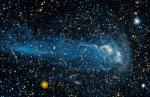 The Tail of a Wonderful Star
17.08.2007
To seventeenth century astronomers, Omicron Ceti or Mira was known as a wonderful star, a star whose brightness could change dramatically in the course of about 11 months. Mira is now seen as the archetype of an entire class of long-period variable stars.
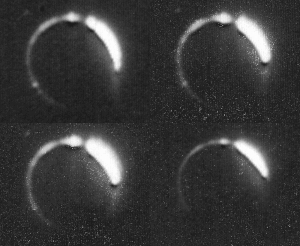 A Solar Eclipse from the Moon
7.04.2014
Has a solar eclipse ever been seen from the Moon? Yes, first in 1967 -- but it may happen again next week. The robotic Surveyor 3 mission took thousands of wide angle television images of the Earth in 1967, a few of which captured the Earth moving in front of the Sun.
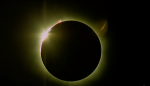 Cheering a Total Solar Eclipse
15.03.2016
What would you do if you saw the Sun disappear? Quite possibly: cheer. That's what many exuberant sky watchers did across Indonesia during a total eclipse of the Sun last week. There and then, the land and sky went dark during the day as our Sun disappeared for a few minutes behind our Moon.
 A Total Lunar Eclipse Corona
9.06.2021
This moon appears multiply strange. This moon was a full moon, specificallyбcalled a Flower Moon at this time of the year. But that didn't make it strange -- full moons occur once a month (moon-th).
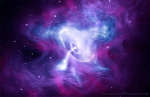 The Spinning Pulsar of the Crab Nebula
21.08.2022
At the core of the Crab Nebula lies a city-sized, magnetized neutron star spinning 30 times a second. Known as the Crab Pulsar, it is the bright spot in the center of the gaseous swirl at the nebula's core.
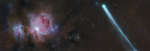 APOD: 2026 May 12 Б The Conjunction of Comet R3 PanSTARRS and the Orion Nebula
12.05.2026
TodayБs composite image features something old, something new, something borrowed, and something blue! Comet R3 PanSTARRS, streaking across the right of the image, likely originated from the Oort Cloud, meaning it is an old Solar System relic from billions of years ago.
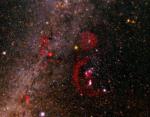 Canaries Sky
10.04.1999
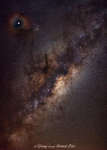
This gorgeous view of stars, nebulae, and the Milky Way comes from the dark night sky above the lovely island of La Palma in the Canaries archipelago. The picture was made by a group...
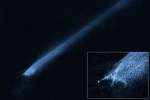 P2010 A2: Unusual Asteroid Tail Implies Powerful Collision
3.02.2010
What is this strange object? First discovered on ground based LINEAR images on January 6, the object appeared unusual enough to investigate further with the Hubble Space Telescope last week. Pictured above, what Hubble saw indicates that P/2010 A2 is unlike any object ever seen before.
 A Total Lunar Eclipse Over Tajikistan
5.10.2014
If the full Moon suddenly faded, what would you see? The answer during the total lunar eclipse of 2011 June was recorded in a dramatic time lapse video from Tajikistan. During a total lunar eclipse, the Earth moves between the Moon and the Sun, causing the moon to fade dramatically.
 Pickering s Triangle in the Veil
17.09.2015
Chaotic in appearance, these filaments of shocked, glowing gas break across planet Earth's sky toward the constellation of Cygnus, as part of the Veil Nebula. The Veil Nebula itself is a large supernova remnant, an expanding cloud born of the death explosion of a massive star.
|
January February March April May June July August September |
|||||||||||||||||||||||||||||||||||||||||||||||||