
|
You entered: time
 Mira: The Wonderful Star
5.05.2005
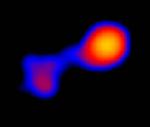
To seventeenth century astronomers, Omicron Ceti or Mira was known as a wonderful star - a star whose brightness could change dramatically in the course of about 11 months. Modern astronomers now recognize an entire class of long period Mira-type variables as cool, pulsating, red giant stars, 700 or so times the diameter of the Sun.
 X-Ray Stars Of Orion
3.02.2000
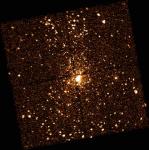
The stars of Orion shine brightly in northern winter skies where the constellation harbors the closest large stellar nursery, the Great Nebula of Orion, a mere 1500 light-years away. In fact, the apparently bright...
 Flying Over the Columbia Hills of Mars
19.05.2008
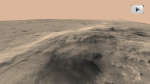
What it would be like to fly over Mars? Combining terrain data from the orbiting Mars Global Surveyor spacecraft (now dormant) with information about the robotic Spirit rover currently rolling across Mars has resulted in a digital movie that shows what a flight over the Columbia Hills might look like.
 Sun 360: STEREO Captures Views of the Entire Sun
6.02.2011
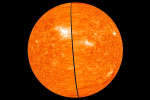
For the first time, the entire Sun is being imaged all at once. This has become possible because the two STEREO satellites orbiting and monitoring the Sun are now on opposite sides of the Sun.
 The Moon During a Total Lunar Eclipse
24.05.2021
How does the Moon's appearance change during a total lunar eclipse? The featured time-lapse video was digitally processed to keep the Moon bright and centered during the 5-hour eclipse of 2018 January 31. At first the full moon is visible because only a full moon can undergo a lunar eclipse.
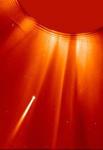 SOHO Sungrazer
1.09.2000
SOHO, the space-based SOlar and Heliospheric Observatory, has become by far the reigning champion facility for discovering comets, its total having recently reached 200. As might be expected of a solar observatory, most of the SOHO discovered comets are sungrazers, destined to dive within a mere 50 thousand kilometers or so of the solar photosphere.
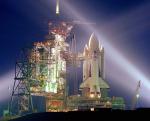 STS 1: First Shuttle Launch
12.04.2001
On April 12, 1981, twenty years ago today, the Space Shuttle Columbia became the first shuttle to orbit the Earth. In this gorgeous time exposure, flood lights play on the Columbia and service structures (left) as it rests atop Complex 39's Pad A at Kennedy Space Center in preparation for first launch.
 The Farthest Explosion Yet Measured
19.10.2000
It happened so far away that common human distance measures are inadequate to describe it. Furthermore, astronomers do not even claim to know exactly what happened. What is known is that satellites across our Solar System reported on 2000 January 31 a tremendous explosion of gamma rays had occurred towards some previously uninteresting direction.
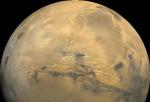 Mars: Just The Facts
27.06.1997
Mars, the freeze-dried planet, orbits 137 million miles from the Sun or at about 1.5 times the Earth-Sun distance. It has two diminutive moons, towering extinct volcanos, an immense canyon system, a thin atmosphere...
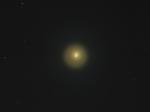 A Telescopic View of Erupting Comet Holmes
28.10.2007
What's happened to Comet Holmes? A normally docile comet discovered over 100 years ago, Comet 17P/Holmes suddenly became nearly one million times brighter last week, possibly over just a few hours. In astronomical...
|
January February March April May June July August September |
|||||||||||||||||||||||||||||||||||||||||||||||||