
|
You entered: time
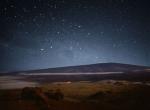 Southern Cross in Mauna Loa Skies
25.04.2002
Gazing across this gorgeous skyscape, the Southern Cross and stars of the constellation Centaurus are seen above the outline of Mauna Loa (Long Mountain), planet Earth's largest volcano. Unfamiliar to sky gazers north...
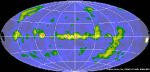 The COMPTEL Gamma-Ray Sky
29.05.1996
This premier gamma-ray view of the sky was produced by the COMPTEL instrument onboard NASA's orbiting Compton Gamma Ray Observatory. The entire sky is seen projected on a coordinate system centered on our Milky Way Galaxy with the plane of the Galaxy running across the middle of the picture.
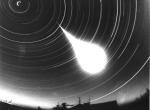 On The Trail Of A Fireball
19.02.1999
This exceptionally bright fireball meteor trail was photographed with a fish-eye camera at a Czech Republic station of the European Fireball Network on January 21, 1999. Of the star trails visible in this night-long exposure, the bright short arc in the upper left is due to Polaris, the north star.
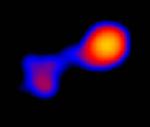 Mira: The Wonderful Star
22.07.2006
To seventeenth century astronomers, Omicron Ceti or Mira was known as a wonderful star - a star whose brightness could change dramatically in the course of about 11 months. Modern astronomers now recognize an entire class of long period Mira-type variables as cool, pulsating, red giant stars, 700 or so times the diameter of the Sun.
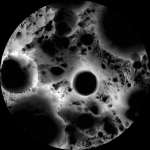 Shadows at the Lunar South Pole
23.04.2011
What is it? It's a multi-temporal illumination map, of course. To make it, the wide angle camera on the Lunar Reconnaissance Orbiter spacecraft collected 1,700 images over a period of 6 lunar days (6 Earth months), repeatedly covering an area centered on the Moon's south pole.
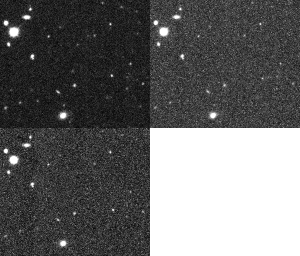 2012 VP113: A New Furthest Known Object in Solar System
31.03.2014
What is the furthest known object in our Solar System? The new answer is 2012 VP113, an object currently over twice the distance of Pluto from the Sun. Pictured above is a series...
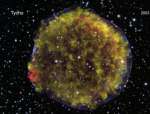 Tychos Supernova Remnant Expands
1.06.2016
What star created this huge expanding puffball? Featured here is the first expansion movie ever created for Tycho's supernova remnant, the result of a stellar explosion first recorded over 400 years ago by the famous astronomer Tycho Brahe.
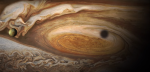 Juno Mission Trailer
28.06.2016
What will NASA's Juno spacecraft find when it reaches Jupiter next Monday? Very little, if Juno does not survive Jupiter Orbit Insertion, a complex series of operations in an unknown environment just above Jupiter's cloud tops.
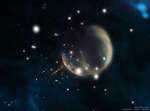 Supernova Cannon Expels Pulsar J0002
13.08.2019
What could shoot out a neutron star like a cannon ball? A supernova. About 10,000 years ago, the supernova that created the nebular remnant CTB 1 not only destroyed a massive star but blasted its newly formed neutron star core -- a pulsar -- out into the Milky Way Galaxy.
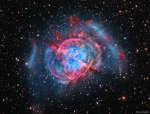 M27: The Dumbbell Nebula
3.12.2019
Is this what will become of our Sun? Quite possibly. The first hint of our Sun's future was discovered inadvertently in 1764. At that time, Charles Messier was compiling a list of diffuse objects not to be confused with comets.
|
January February March April May June July August September |
|||||||||||||||||||||||||||||||||||||||||||||||||