
|
You entered: time
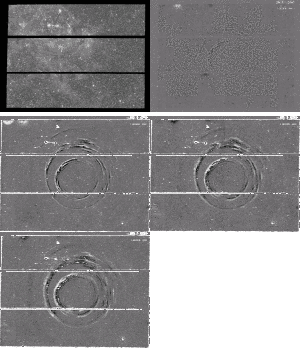 The Expanding Light Echoes of SN 1987A
25.01.2006
Can you find supernova 1987A? It isn't hard -- it occurred at the center of the expanding bullseye pattern. Although this stellar detonation was first seen almost two decades ago, light from it continues to bounce off clumps of interstellar dust and be reflected to us today.
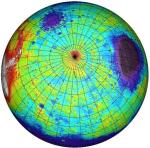 Southern Mars
3.12.1999
This topographical map of the southern hemisphere of Mars was generated using data from the Mars Orbiter Laser Altimeter (MOLA). Flying on the Mars Global Surveyor spacecraft, MOLA has bounced a laser beam off the Martian surface over 200,000,000 times producing a wealth of detailed elevation measurements.
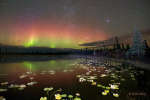 Reflected Aurora Over Alaska
12.02.2013
Some auroras can only be seen with a camera. They are called subvisual and are too faint to be seen with the unaided eye. In the above image, the green aurora were easily visible to the eye, but the red aurora only became apparent after a 20-second camera exposure.
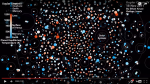 Kepler Orrery IV
5.12.2015
The exoplanet hunting Kepler mission's total for candidate and confirmed multiple planet systems stands at 1,705 worlds in orbit around 685 distant stars. Put all of those exoplanet orbits on the same scale and follow their relative orbital motions to get Kepler Orrery IV.
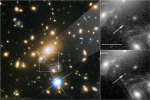 Fortuitous Flash Candidate for the Farthest Star Yet Seen
11.04.2018
Was this flash the farthest star yet seen? An unexpected flash of light noticed fortuitously on Hubble Space Telescope images may prove to be not only an unusual gravitational lensing event but also an image of a normal star 100 times farther away than any star previously imaged individually.
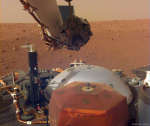 Sound and Light Captured by Mars InSight
10.12.2018
Your arm on Mars has unusual powers. For one thing it is nearly 2 meters long, has a scoop and grapple built into its hand, and has a camera built into its forearm. For another, it will soon deploy your ear -- a sensitive seismometer that will listen for distant rumblings -- onto the surface of Mars.
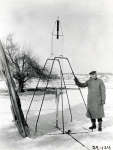 APOD: 2026 March 28 Б Robert Goddard and Nell
28.03.2026
Robert H. Goddard, considered the father of modern rocketry, was born in Worcester Massachusetts in 1882. As a 16 year old, Goddard read H.G. Wells' science fiction classic "War Of The Worlds" and dreamed of space flight. By 1926 he had designed, built, and flown the world's first liquid fuel rocket.
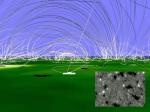 The Magnetic Carpet Of The Sun
6.11.1997
The Sun has a magnetic carpet. Its visible surface appears to be carpeted with tens of thousands of magnetic north and south poles joined by looping field lines which extend outward into the Solar Corona.
 Dark River Wide Field
19.07.2010
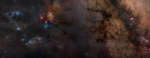
A Dark River of dust seems to run from our Galactic Center, then pool into a starfield containing photogenic sky wonders. Scrolling right will reveal many of these objects including (can you find?)...
 The Meteor of 1860
22.07.2010
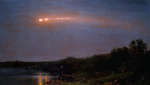
Frederic Church (1826-1900), American landscape painter of the Hudson River School, painted what he saw in nature. And on July 20th, 1860, he saw a spectacular string of fireball meteors cross the Catskill evening sky, an extremely rare Earth-grazing meteor procession.
|
January February March April May June July August September |
|||||||||||||||||||||||||||||||||||||||||||||||||