
|
You entered: time
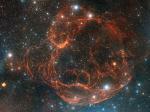 Simeis 147: Supernova Remnant from Palomar
29.11.2005
It's easy to get lost following the intricate filaments in this detailed image of faint supernova remnant Simeis 147. Seen towards the constellation Taurus it covers nearly 3 degrees (6 full moons) on the sky corresponding to a width of 150 light-years at the stellar debris cloud's estimated distance of 3,000 light-years.
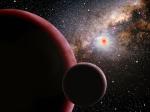 Super Earths May Circle Other Stars
20.03.2006
Are "super-Earths" common around other star systems? Quite possibly. Unexpected evidence for this came to light recently when a planet orbiting a distant star gravitationally magnified the light of an even more distant star.
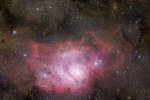 The Lagoon Nebula from GigaGalaxy Zoom
6.10.2009
The large majestic Lagoon Nebula is home for many young stars and hot gas. Spanning 100 light years across while lying only about 5000 light years distant, the Lagoon Nebulae is so big and bright that it can be seen without a telescope toward the constellation of Sagittarius.
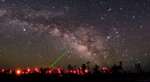 Messier Marathon
27.05.2011
In this action scene, red night vision lights, green laser pointers, tripods and telescopes in faint silhouette surround intrepid sky gazers embarked on the 10th annual Iran Messier Marathon. Completing the marathon requires viewing all 110 objects in 18th century French astronomer Charles Messier's catalog in one glorious dusk-to-dawn observing run.
 Hammer Versus Feather on the Moon
1.11.2011
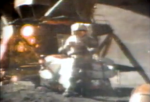
If you drop a hammer and a feather together, which reaches the ground first? On the Earth, it's the hammer, but is the reason only because of air resistance? Scientists even before Galileo have pondered and tested this simple experiment and felt that without air resistance, all objects would fall the same way.
 A Plurality of Singularities at the Galactic Center
12.05.2018
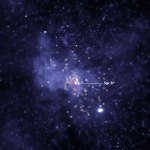
A recent informal poll found that astronomers don't yet have a good collective noun for a group of black holes, but they need one. The red circles in this Chandra Observatory X-ray image identify a group of a dozen black holes that are members of binary star systems.
 NGC 6164: Dragons Egg Nebula and Halo
26.12.2022
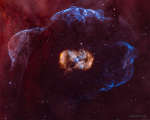
The star at the center created everything. Known as the Dragon's Egg, this star -- a rare, hot, luminous O-type star some 40 times as massive as the Sun -- created not only the complex nebula (NGC 6164) that immediately surrounds it, but also the encompassing blue halo.
 Stickney Crater
8.07.2023
Stickney Crater, the largest crater on the martian moon Phobos, is named for Chloe Angeline Stickney Hall, mathematician and wife of astronomer Asaph Hall. Asaph Hall discovered both the Red Planet's moons in 1877.
 Jones Emberson 1
12.07.2024
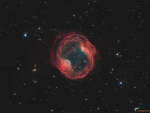
Planetary nebula Jones-Emberson 1 is the death shroud of a dying Sun-like star. It lies some 1,600 light-years from Earth toward the sharp-eyed constellation Lynx. About 4 light-years across, the expanding remnant...
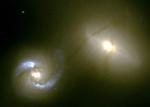 NGC 1410/1409: Intergalactic Pipeline
12.01.2001
These two galaxies are interacting in a surprising way, connected by a "pipeline" of obscuring material that runs between them over 20,000 light-years of intergalactic space. Silhouetted by starlight, the dark, dusty ribbon appears to stretch from NGC 1410 (the galaxy at the left) and wrap itself around NGC 1409 (at right).
|
January February March April May June July August September |
|||||||||||||||||||||||||||||||||||||||||||||||||