
|
You entered: origin
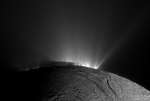 Shadows and Plumes Across Enceladus
4.08.2014
Why does Enceladus have ice plumes? The discovery of jets spewing water vapor and ice was detected by the Saturn-orbiting Cassini spacecraft in 2005. The origin of the water feeding the jets, however, remained a topic of research.
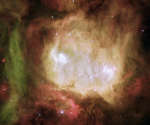 Halloween and the Ghost Head Nebula
31.10.2010
Halloween's origin is ancient and astronomical. Since the fifth century BC, Halloween has been celebrated as a cross-quarter day, a day halfway between an equinox (equal day / equal night) and a solstice (minimum day / maximum night in the northern hemisphere). With a modern calendar, however, the real cross-quarter day will occur next week.
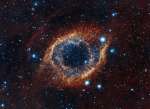 The Helix Nebula from the VISTA Telescope
31.01.2012
Will our Sun look like this one day? The Helix Nebula is one of brightest and closest examples of a planetary nebula, a gas cloud created at the end of the life of a Sun-like star.
 Unusual Spherules on Mars
10.02.2004
What are those unusual spherules on Mars? The Mars Opportunity rover has now photographed several unusual nodules on Mars that have a nearly spherical shape. Many times these spherules are embedded in larger rock outcroppings but appear grayer.
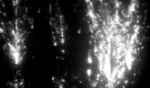 Sprite Lightning at 100000 Frames Per Second
4.01.2021
What causes sprite lightning? Mysterious bursts of light in the sky that momentarily resemble gigantic jellyfish have been recorded for over 30 years, but apart from a general association with positive cloud-to-ground lightning, their root cause remains unknown. Some thunderstorms have them -- most don't.
 Stereo Eros
17.02.2007
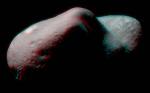
Get out your red/blue glasses and float next to asteroid 433 Eros, now over 220 million kilometers away! Orbiting the Sun once every 1.8 earth-years, asteroid Eros is a diminutive 40 x 14 x 14 kilometer world of undulating horizons, craters, boulders and valleys.
 Halloween and the Ghost Head Nebula
31.10.2007
Halloween's origin is ancient and astronomical. Since the fifth century BC, Halloween has been celebrated as a cross-quarter day, a day halfway between an equinox (equal day / equal night) and a solstice (minimum day / maximum night in the northern hemisphere). With our modern calendar, however, the real cross-quarter day will occur next week.
 Halloween and the Ghost Head Nebula
31.10.2001
Halloween's origin is ancient and astronomical. Since the fifth century BC, Halloween has been celebrated as a cross-quarter day, a day halfway between an equinox (equal day / equal night) and a solstice (minimum day / maximum night in the northern hemisphere). With our modern calendar, however, the real cross-quarter day will occur next week.
 Major Fireball Meteor
17.11.2017
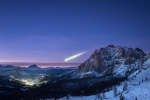
The sky glows with soft pinkish colors of fading twilight in this serendipitous mountaintop vista. Taken in subfreezing temperatures, the thoughtfully composed photo shows snowy, rugged peaks seen from a mountain pass on November 14. Below lies the village of La Villa, Alta Badia in Italy's Dolomite Alps.
 Space Station Detector Finds Unexplained Positron Excess
6.10.2014
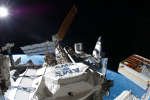
Where did all these high energy positrons come from? The Alpha Magnetic Spectrometer (AMS-02) onboard the International Space Station (ISS) has been meticulously recording how often it is struck by both high energy electrons and positrons since 2011.
|
January February March April May June July August |
||||||||||||||||||||||||||||||||||||||||||||||||||||||||