
|
You entered: origin
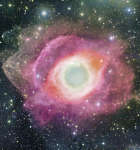 The Helix Nebula from CFHT
23.11.2020
Will our Sun look like this one day? The Helix Nebula is one of brightest and closest examples of a planetary nebula, a gas cloud created at the end of the life of a Sun-like star.
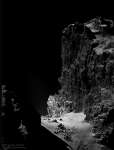 A High Cliff on Comet Churyumov Gerasimenko
27.11.2021
This high cliff occurs not on a planet, not on a moon, but on a comet. It was discovered to be part of the dark nucleus of Comet Churyumov-Gerasimenko (CG) by Rosetta, a robotic spacecraft launched by ESA that rendezvoused with the Sun-orbiting comet in 2014.
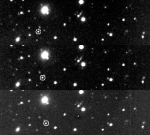 Irregular Moons Discovered Around Uranus
2.11.1997
Where did these two irregular moons of Uranus originate? Last week two previously undiscovered moons of the distant gas planet were confirmed, the first in irregular orbits. All fifteen previously known moons of Uranus are 'regular', circling near the planet's equator. Most of these were discovered by the passing Voyager 2 spacecraft in 1986.
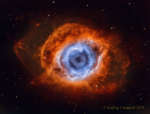 The Helix Nebula in Hydrogen and Oxygen
12.02.2019
Is the Helix Nebula looking at you? No, not in any biological sense, but it does look quite like an eye. The Helix Nebula is so named because it also appears that you are looking down the axis of a helix.
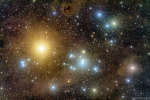 The Hyades Star Cluster
21.01.2020
It is the closest cluster of stars to the Sun. The Hyades open cluster is bright enough to have been remarked on even thousands of years ago, yet is not as bright or compact as the nearby Pleiades (M45) star cluster.
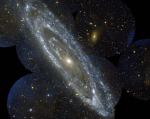 The Andromeda Galaxy from GALEX
21.12.2003
Why does the Andromeda Galaxy have a giant ring? Viewed in ultraviolet light, the closet major galaxy to our Milky Way Galaxy looks more like a ring galaxy than a spiral. The ring...
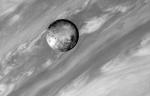 5 Million Miles From Io
10.03.1999
Twenty years ago this month, NASA's Voyager 1 spacecraft flew past Jupiter and its moons. This sharp picture of moon Io against a background of gas giant Jupiter's diffuse swirling cloud bands was recorded by Voyager's camera from a distance of about 5 million miles.
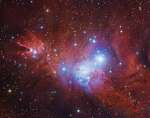 In the Vicinity of the Cone Nebula
6.08.2013
Strange shapes and textures can be found in neighborhood of the Cone Nebula. The unusual shapes originate from fine interstellar dust reacting in complex ways with the energetic light and hot gas being expelled by the young stars.
 A Giant Gouge on Asteroid Eros
20.02.2000
Asteroid 433 Eros is posing several riddles. NASA's robot spacecraft NEAR began orbiting the 30-kilometer space rock last week, and new pictures are now being beamed back to Earth regularly. As usual in science, when you arrive at a place you've never been before, you see things you don't immediately understand.
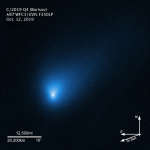 Interstellar Interloper 2I Borisov
17.10.2019
After the 2017 detecton of 1I/'Oumuamua, comet 2I/Borisov has become the second recognized interstellar interloper. Like 'Oumuamua, Borisov's measured hyperbolic trajectory and speed as it falls toward the Sun confirm that its origin is from beyond our Solar System.
|
January February March April May June July August |
||||||||||||||||||||||||||||||||||||||||||||||||||||||||