
|
You entered: origin
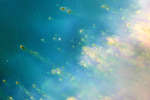 Curious Cometary Knots in the Helix Nebula
13.04.2008
What causes unusual knots of gas and dust in planetary nebulas? Seen also in the Ring Nebula, the Dumbbell Nebula and the Eskimo Nebula, the knots' existence was not initially predicted and their origins are still not well understood.
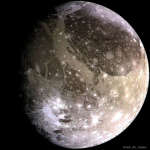 Ganymede: The Largest Moon
14.05.2017
What does the largest moon in the Solar System look like? Jupiter's moon Ganymede, larger than even Mercury and Pluto, has an icy surface speckled with bright young craters overlying a mixture of older, darker, more cratered terrain laced with grooves and ridges.
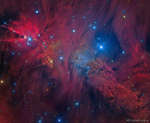 In the Vicinity of the Cone Nebula
16.04.2019
Strange shapes and textures can be found in neighborhood of the Cone Nebula. The unusual shapes originate from fine interstellar dust reacting in complex ways with the energetic light and hot gas being expelled by the young stars.
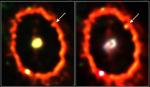 Shocked by Supernova 1987A
23.02.2002
Fifteen years ago today, the brightest supernova of modern times was sighted. Over time, astronomers have watched and waited for the expanding debris from this tremendous stellar explosion to crash into previously expelled material.
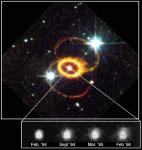 Supernova 1987a Fireball Resolved
24.01.1997
Ten years ago the most notable supernova of modern times was observed. In February 1987, light reached Earth from a star which exploded in the nearby Large Magellanic Cloud galaxy. Supernova 1987a remains the closest supernova since the invention of the telescope.
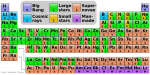 Where Your Elements Came From
25.01.2016
The hydrogen in your body, present in every molecule of water, came from the Big Bang. There are no other appreciable sources of hydrogen in the universe. The carbon in your body was made by nuclear fusion in the interior of stars, as was the oxygen.
 APOD: 2023 June 7 Б M94: A Double Ring Galaxy
7.06.2023
Most galaxies don't have any rings of stars and gas -- why does M94 have two? First, spiral galaxy M94 has an inner ring of newly formed stars surrounding its nucleus, giving it not only an unusual appearance but also a strong interior glow.
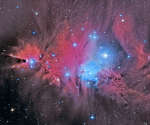 In the Vicinity of the Cone Nebula
13.12.2011
Strange shapes and textures can be found in neighborhood of the Cone Nebula. The unusual shapes originate from fine interstellar dust reacting in complex ways with the energetic light and hot gas being expelled by the young stars.
 APOD: 2025 August 4 Б Blue Arcs Toward Andromeda
4.08.2025
What are these gigantic blue arcs near the Andromeda Galaxy (M31)? Discovered in 2022 by amateur astronomers, the faint arcs -- dubbed SDSO 1 -- span nearly the same angular size as M31 itself. At first, their origin was a mystery: are they actually near the Andromeda Galaxy, or alternatively near to our Sun?
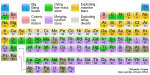 Where Your Elements Came From
24.10.2017
The hydrogen in your body, present in every molecule of water, came from the Big Bang. There are no other appreciable sources of hydrogen in the universe. The carbon in your body was made by nuclear fusion in the interior of stars, as was the oxygen.
|
January February March April May June July August |
||||||||||||||||||||||||||||||||||||||||||||||||||||||||