
|
You entered: origin
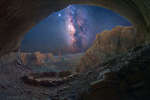 A True Image from False Kiva
29.09.2008
Is there any place in the world you could see a real sight like this? Yes. Pictured above is single exposure image spectacular near, far, and in between. Diving into the Earth far in the distance is part of the central band of our Milky Way Galaxy, taken with a long duration exposure.
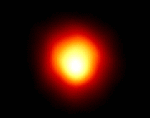 Betelgeuse, Betelgeuse, Betelgeuse
22.01.1996
Betelgeuse (sounds a lot like "beetle juice"), a red supergiant star about 600 lightyears distant, is shown here in this Hubble Space Telescope image which represents the first direct picture of the surface of a star other than the Sun.
 Cassini Images Saturns A Ring
12.07.2004
What are Saturn's rings made of? In an effort to find out, the robot spacecraft Cassini that entered orbit around Saturn two weeks ago took several detailed images of the area surrounding Saturn's large A ring in ultraviolet light.
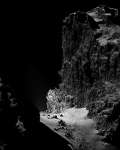 The Cliffs of Comet Churyumov Gerasimenko
22.12.2014
These high cliffs occur on the surface of a comet. They were discovered to be part of the dark nucleus of Comet ChuryumovGerasimenko (CG) by Rosetta, a robotic spacecraft launched by ESA which began orbiting the comet in early August. The ragged cliffs, as featured here, were imaged by Rosetta about two weeks ago.
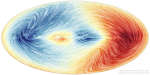 Milky Way Motion in 3D from Gaia
6.07.2022
Our sky is alive with the streams of stars. The motions of 26 million Milky Way stars are evident in the featured map constructed from recent data taken by ESA's Gaia satellite. Stars colored blue are moving toward us, while red indicates away. Lines depict the motion of the stars across the sky.
 An Anomalous SETI Signal
7.03.2004
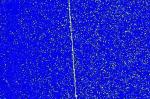
No one knows for sure what caused this signal. There is a slight possibility that it just might originate from an extraterrestrial intelligence. The bright colors on the blue background indicate that an anomalous signal was received here on Earth by a radio telescope involved in a Search for Extraterrestrial Intelligence (SETI).
 Barnards Loop around the Horsehead Nebula
24.02.2009
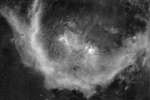
Why is the Horsehead Nebula surrounded by a bubble? Although hard to make out above, the famous Horsehead Nebula is the slight dark indentation in the bright streak just to the left of the image center. Glowing like an emission nebula, the origin of the bubble, known as Barnard's Loop, is currently unknown.
 A Perseid Meteor
11.08.1997
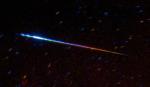
Tonight the Perseid Meteor Shower reaches its maximum. Grains of rocky ice will streak across the sky as they evaporate during entry into Earth's atmosphere. These ice chips were shed from Comet Swift-Tuttle. The Perseids result from the annual crossing of the Earth through Comet Swift-Tuttle's orbit.
 Sprite Lightning in Slow Motion
13.10.2014
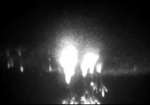
What causes sprite lightning? Mysterious bursts of light in the sky that momentarily resemble gigantic jellyfish have been recorded for over 25 years, but their root cause remains unknown. Some thunderstorms have them -- most don't. Recently, however, high speed videos are better detailing how sprites actually develop.
 NGC 2419 Intergalactic Wanderer
4.06.2015
Three objects stand out in this thoughtful telescopic image, a view toward the mostly stealthy constellation Lynx. The two brightest (the spiky ones) are nearby stars. The third is the remote globular star cluster NGC 2419, at distance of nearly 300,000 light-years.
|
January February March April May June July August |
||||||||||||||||||||||||||||||||||||||||||||||||||||||||