
|
You entered: origin
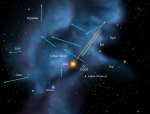 The Local Fluff
24.09.2013
The stars are not alone. In the disk of our Milky Way Galaxy about 10 percent of visible matter is in the form of gas, called the interstellar medium (ISM). The ISM is not uniform, and shows patchiness even near our Sun.
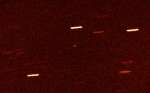 A 2017 U1: An Interstellar Visitor
3.11.2017
Traveling at high velocity along an extreme hyperbolic orbit and making a hairpin turn as it swung past the Sun, the now designated A/2017 U1 is the first known small body from interstellar space.
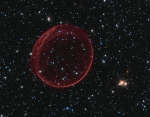 The Rippled Red Ribbons of SNR 0509
25.01.2011
What is causing the picturesque ripples of supernova remnant SNR 0509-67
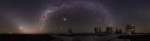 Wonder and Mystery above the Very Large Telescopes
9.05.2011
What's that bright orange dot above the large telescope on the right? Even seasoned sky enthusiasts might ponder the origin of the orange orb seen by scrolling across this panoramic image, taken last December. Perhaps identifying known objects will help.
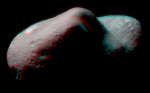 Stereo Eros
13.02.2021
Get out your red/blue glasses and float next to asteroid 433 Eros. Orbiting the Sun once every 1.8 years, the near-Earth asteroid is named for the Greek god of love. Still, its shape more closely resembles a lumpy potato than a heart.
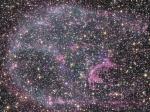 Supernova Remnant N132D in Optical and X Rays
25.10.2005
Thousands of years after a star exploded, its expanding remnant still glows brightly across the spectrum. Such is the case with N132D, a supernova remnant located in the neighboring Large Magellanic Cloud (LMC) galaxy. The expanding shell from this explosion now spans 80 light-years and has swept up about 600 Suns worth of mass.
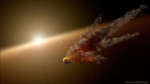 Unexplained Dimmings in KIC 8462852
13.06.2016
Why does star KIC 8462852 keep wavering? Nobody knows. A star somewhat similar to our Sun, KIC 8462852 was one of many distant stars being monitored by NASA's robotic Kepler satellite to see if it had planets.
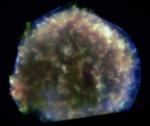 X Rays From Tycho s Supernova Remnant
12.09.2002
In 1572, Danish astronomer Tycho Brahe recorded the sudden appearance of a bright new star in the constellation Cassiopeia. The new star faded from view over a period of months and is believed to have been a supernova, one of the last stellar explosions seen in our Milky Way galaxy.
 Animation: Odd Radio Circles
30.03.2022
What do you call a cosmic puzzle that no one expected to see? In this case, Odd Radio Circles, aka ORCs. ORC-1 typifies the enigmatic five objects, only visible at radio frequencies, that were serendipitously discovered in 2019 using the new Australian SKA Pathfinder radio array.
 A Double Ringed Basin on Mercury
7.10.2009
What created the internal second ring of this double ringed basin on Mercury? No one is sure. The unusual feature spans 160 kilometers and was imaged during the robotic MESSENGER spacecraft's swing past our Solar System's innermost planet last week.
|
January February March April May June July August |
||||||||||||||||||||||||||||||||||||||||||||||||||||||||