
|
You entered: time
 Annular Eclipse: The Ring of Fire
10.06.2002
Today, a few lucky people will see a "ring of fire." That's a name for the central view of an annular eclipse of the Sun by the Moon. At the peak of this...
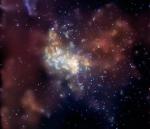 X Rays from the Galactic Core
7.01.2003
Using the orbiting Chandra X-ray Observatory, astronomers have taken this long look at the core of our Milky Way galaxy, some 26,000 light-years away. The spectacular false-color view spans about 130 light-years.
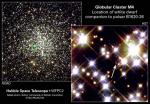 The Planet, the White Dwarf, and the Neutron Star
18.07.2003
A planet, a white dwarf, and a neutron star orbit each other in the giant globular star cluster M4, some 5,600 light-years away. The most visible member of the trio is the white...
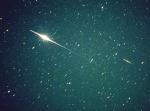 Iridium Flare
2.04.1998
Have you seen an Iridium flare? Satellites in low Earth orbit reflect sunlight and are often visible gliding across early evening and predawn skies. But sun glints from Iridium commercial digital communications satellites are providing the most spectacular sightings.
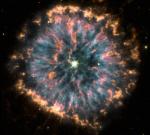 Celebrating Hubble With NGC 6751
16.04.2005
Planetary nebulae can look simple, round, and planet-like in small telescopes. But images from the orbiting Hubble Space Telescope have become well known for showing these fluorescent gas shrouds of dying Sun-like stars to possess a staggering variety of detailed symmetries and shapes.
 Victoria Crater on Mars
22.10.2007
Scroll right to see the largest crater yet visited by a rover on Mars. Reaching the expansive Victoria Crater has been a goal for the robotic Opportunity rover rolling across Mars for the past two years. Victoria crater has about five times the diameter of Endurance Crater, which Opportunity spent six months exploring.
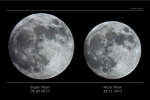 Super Moon vs Micro Moon
12.11.2016
What is so super about tomorrow's supermoon? Tomorrow, a full moon will occur that appears slightly larger and brighter than usual. The reason is that the Moon's fully illuminated phase occurs within a short time from perigee - when the Moon is its closest to the Earth in its elliptical orbit.
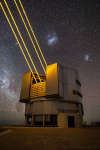 Firing Lasers to Tame the Sky
9.02.2021
Why do stars twinkle? Our atmosphere is to blame as pockets of slightly off-temperature air, in constant motion, distort the light paths from distant astronomical objects. Atmospheric turbulence is a problem for astronomers because it blurs the images of the sources they want to study.
 APOD: 2024 May 12 Б Red Aurora over Poland
11.05.2024
Northern lights don't usually reach this far south. Magnetic chaos in the Sun's huge Active Region 3664, however, produced a surface explosion that sent a burst of electrons, protons, and more massive, charged nuclei into the Solar System.
 APOD: 2024 June 2 Б Rotating Moon from LRO
1.06.2024
No one, presently, sees the Moon rotate like this. That's because the Earth's moon is tidally locked to the Earth, showing us only one side. Given modern digital technology, however, combined with many detailed images returned by the Lunar Reconnaissance Orbiter (LRO), a high resolution virtual Moon rotation movie has been composed.
|
January February March April May June July August September |
|||||||||||||||||||||||||||||||||||||||||||||||||