
|
You entered: time
 Eclipse Pair
2.01.2025
Eclipses tend to come in pairs. Twice a year, during an eclipse season that lasts about 34 days, Sun, Moon, and Earth can nearly align. Then the full and new phases of the Moon, separated by just over 14 days, create a lunar and a solar eclipse.
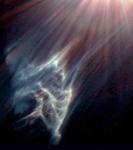 Reflecting Merope
5.12.2000
In the famous Pleiades star cluster, a star's light is slowly destroying a passing cloud of gas and dust. The star, Merope, lies just off the upper right edge of this recently released picture by the Hubble Space Telescope.
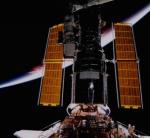 Hubble Holiday
23.12.1999
How would you like to spend your holiday in low earth orbit? That's what the crew of the space shuttle Discovery is doing as they deliver six new gyros and a faster main computer to the orbiting Hubble Space Telescope.
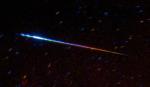 A Perseid Meteor
12.08.2000
This weekend, the annual Perseid Meteor Shower reaches its maximum. Grains of cosmic sand and gravel shed from Comet Swift-Tuttle will streak across the sky as they vaporize during entry into Earth's atmosphere. The Perseids result from the yearly
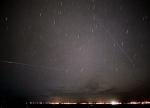 Mir Flares Farewell
22.03.2001
Streaking low across the western horizon after sunset, the Russian Mir space station makes a final pass through the evening sky above the coastal city of Salvador, Brazil. In this 5 minute 20 second time exposure made with ASA 800 film and a wide-angle lens on March 19, setting stars leave short, almost vertical trails.
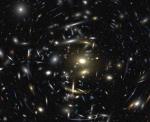 Simulated Galaxy Cluster View
5.03.2002
Stunningly detailed, this picture is a computer simulated view of a cluster of galaxies in the distant cosmos. A large, elliptical galaxy dominates this hypothetical cluster's central region surrounded by a swarm of member galaxies.
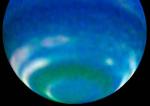 Neptune: Still Springtime After All These Years
13.06.2003
In the 1960s spring came to the southern hemisphere of Neptune, the Solar System's outermost gas giant planet. Of course, since Neptune orbits the Sun once every 165 earth-years, it's still spring for southern Neptune, where each season lasts over four decades.
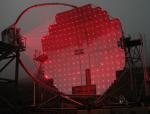 Night MAGIC
15.10.2004
Is it magic? On a rare foggy night, mysterious laser beams seem to play across the MAGIC telescope at Roque de los Muchachos on the Canary Island of La Palma. The lasers are actually part of a system designed to automatically adjust the focusing of the inovative, seventeen meter wide, multi-mirrored instrument.
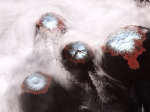 Islands of Four Mountains from Above
22.06.2010
Our Earth is covered by volcanoes. Volcanoes are breaks in the Earth's cool surface where hot liquid rock from the interior comes out -- sometimes suddenly. In the above image from the ASTER camera...
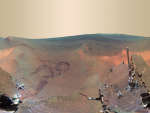 Greeley Panorama on Mars
9.07.2012
What did you do over your winter vacation? If you were the Opportunity rover on Mars, you spent four months of it stationary and perched on the northern slope of Greeley Haven -- and tilted so that your solar panels could absorb as much sunlight as possible.
|
January February March April May June July August September |
|||||||||||||||||||||||||||||||||||||||||||||||||