
|
You entered: time
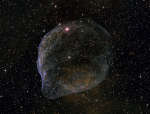 Sharpless 308: Star Bubble
24.12.2013
Blown by fast winds from a hot, massive star, this cosmic bubble is huge. Cataloged as Sharpless 2-308 it lies some 5,200 light-years away toward the constellation of the Big Dog (Canis Major) and covers slightly more of the sky than a Full Moon.
 APOD: 2023 July 9 Б Doomed Star Eta Carinae
8.07.2023
Eta Carinae may be about to explode. But no one knows when - it may be next year, it may be one million years from now. Eta Carinae's mass - about 100 times greater than our Sun - makes it an excellent candidate for a full blown supernova.
 APOD: 2023 November 7 Б A Martian Dust Devil Spins By
6.11.2023
It moved across the surface of Mars -- what was it? A dust devil. Such spinning columns of rising air are heated by the warm surface and are also common in warm and dry areas on planet Earth.
 APOD: 2024 September 9 Б Mars: Moon, Craters, and Volcanos
8.09.2024
If you could fly over Mars, what might you see? The featured image shows exactly this in the form of a Mars Express vista captured over a particularly interesting region on Mars in July. The picture's most famous feature is Olympus Mons, the largest volcano in the Solar System, visible on the upper right.
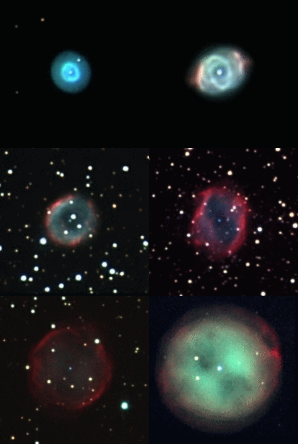 The Planetary Nebula Show
3.10.2001
What do the Owl, the Cat's Eye, the Ghost of Jupiter, and Saturn have in common? They're all planetary nebulae of course(!), glowing gaseous shrouds shed by dying sun-like stars as they run out of nuclear fuel.
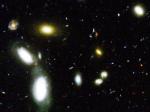 Galaxies in the GOODS
25.06.2003
This tantalizing view of galaxies scattered near and far is part of the Hubble Space Telescope's contribution to the GOODS - the Great Observatories Origins Deep Survey project. The GOODS' goal is to study...
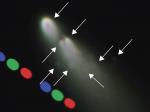 Crumbling Comet Schwassmann Wachmann 3 Approaches
26.04.2006
A crumbling comet will soon pass near the Earth. Comet 73P/Schwassmann-Wachmann 3 is brightening and may even be visible to the unaided eye when the fragmented comet zooms past Earth during the middle of next month.
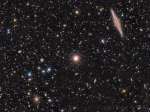 NGC 891 vs Abell 347
11.11.2016
Galaxies abound in this well-chosen field of view that spans about 1 degree on the sky toward the northern constellation Andromeda. At top right is large spiral galaxy NGC 891, 100 thousand light-years across and seen almost exactly edge-on.
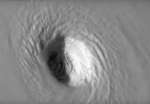 Swirling Around the Eye of Hurricane Irma
9.09.2017
Why does a hurricane have an eye at its center? No one is yet sure. What happens in and around a hurricane's eye is well documented, though. Warm air rises around the eye's edges, cools, swirls, and spreads out over the large storm, sinking primarily at the far edges.
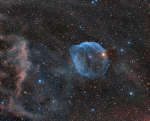 Sharpless 308: Star Bubble
30.01.2019
Blown by fast winds from a hot, massive star, this cosmic bubble is huge. Cataloged as Sharpless 2-308 it lies some 5,200 light-years away toward the constellation of the Big Dog (Canis Major) and covers slightly more of the sky than a Full Moon.
|
January February March April May June July August September |
|||||||||||||||||||||||||||||||||||||||||||||||||