
|
You entered: sky
 APOD: 2024 June 10 Б Sh2 132: The Lion Nebula
10.06.2024
Is the Lion Nebula the real ruler of the constellation Cepheus? This powerful feline appearing nebula is powered by two massive stars, each with a mass over 20 times greater than our Sun. Formed...
 APOD: 2025 July 31 Б Supernova 2025rbs in NGC 7331
31.07.2025
A long time ago in a galaxy 50 million light-years away, a star exploded. Light from that supernova was first detected by telescopes on planet Earth on July 14th though, and the extragalactic transient is now known to astronomers as supernova 2025rbs.
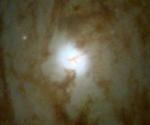 M51: The Center Of The Whirlpool
27.05.2000
In the center of M51, a spiral galaxy 23 million light-years away, astronomers have identified a dense region of young stars. Viewed face-on in the constellation Canes Venatici, the swirling arcs of this galaxy's spiral arms have inspired its popular name, The Whirlpool Galaxy.
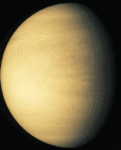 Venus: Earth's Sister Planet
15.08.1995
This picture in visible light was taken by the Galileo spacecraft. Venus is very similar to Earth in size and mass - and so is sometimes referred to as Earth's sister planet - but Venus has a quite different climate.
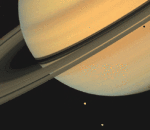 Saturn with Moons Tethys and Dione
18.03.1996
Saturn and two of its larger moons - Tethys and Dione - were photographed by the Voyager 1 spacecraft which flew by the planet in November of 1980. This picture gives an indication of Saturn's extensive ring system, which can be seen casting a shadow on the planet, as does Tethys.
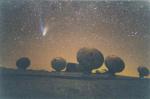 Hale-Bopp and the Plateau de Bure Interferometer
15.04.1997
Comet Hale-Bopp is being observed by many different telescopes. Here the comet is pictured behind the array of radio telescopes which compose the Plateau de Bure Interferometer. These telescopes are being used to detect the presence of different molecules in the coma and tail of Comet Hale-Bopp.
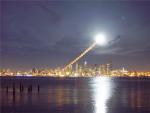 Moonrise Over Seattle
11.10.2003
Is the Moon larger when near the horizon? No -- as shown above, the Moon appears to be very nearly the same size no matter its location on the sky. Oddly, the cause or causes for the common Moon Illusion are still being debated.
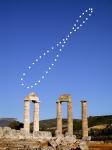 Analemma Over Ancient Nemea
21.06.2004
An anelemma is that figure-8 curve that you get when you mark the position of the Sun at the same time each day throughout planet Earth's year. Above, 44 separate exposures (plus...
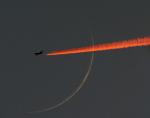 When the Moon Was Young
13.05.2005
Remember when the Moon was young? It was just last Monday. On May 9th, this slender crescent Moon was recorded at a tender age of 34 hours and 18 minutes. Well, OK ... when calculating...
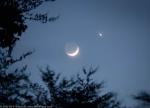 On the Possibility of Ascending to Mars
19.10.2005
On another October 19, in 1899, a 17 year-old Robert Goddard climbed a cherry tree on a beautiful autumn afternoon in Worcester, Massachusetts. Inspired by H.G. Wells' War of the Worlds and gazing...
|
January February March April May June July August September October |
|||||||||||||||||||||||||||||||||||||||||||||||||