
|
You entered: sky
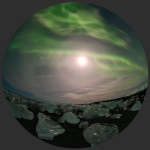 Aurora on Ice
12.02.2015
Not from a snowglobe, this expansive fisheye view of ice and sky was captured on February 1, from Jökulsárlón Beach, southeast Iceland, planet Earth. Chunks of glacial ice on the black sand beach glisten in the light of a nearly full moon surrounded by a shining halo.
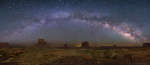 The Milky Way Over Monument Valley
1.11.2015
You don't have to be at Monument Valley to see the Milky Way arch across the sky like this -- but it helps. Only at Monument Valley USA would you see a picturesque foreground that includes these iconic rock peaks called buttes.
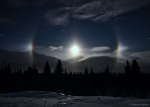 Alaskan Moondogs
21.03.2016
What's happened to the sky? Moonlight illuminates a snowy scene in this night land and skyscape made on 2013 January from Lower Miller Creek, Alaska, USA. Overexposed near the mountainous western horizon is the first quarter Moon itself, surrounded by an icy halo and flanked left and right by moondogs.
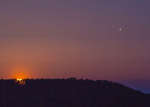 Opposite the Setting Sun
3.05.2018
On April 30, a Full Moon rose opposite the setting Sun. Its yellowish moonglow silhouettes a low tree-lined ridge along Lewis Mountain in this northeastern Alabama skyscape. Sharing the telephoto field-of-view opposite the Sun are Earth's grey shadow, the pinkish Belt of Venus, and bright planet Jupiter.
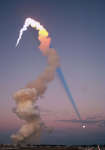 Rocket Plume Shadow Points to the Moon
24.06.2018
Why would the shadow of a space shuttle launch plume point toward the Moon? In early 2001 during a launch of Atlantis, the Sun, Earth, Moon, and rocket were all properly aligned for this photogenic coincidence.
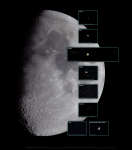 One Night One Telescope One Camera
28.07.2018
Taken on the same night, from the same place, with the same telescope and camera, these postcards from our Solar System are shown at the same scale to provide an interesting comparison of apparent sizes. Spanning about half a degree in planet Earth's sky, the Moon is a stitched mosaic of six images.
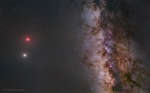 Moon, Mars, and Milky Way
11.08.2018
Just two weeks ago, dark skies over the desert in northern Iran held this alluring celestial vista. The dramatic digital mosaic finds the Moon and Mars alongside the Milky Way's dusty rifts, stars, and nebulae.
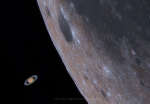 Moon Occults Saturn
9.04.2019
Sometimes Saturn disappears. It doesn't really go away, though, it just disappears from view when our Moon moves in front. Such a Saturnian eclipse was visible along a small swath of Earth -- from Brazil to Sri Lanka -- near the end of last month.
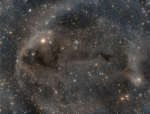 Lynds Dark Nebula 1251
3.07.2020
Stars are forming in Lynds Dark Nebula (LDN) 1251. About 1,000 light-years away and drifting above the plane of our Milky Way galaxy, the dusty molecular cloud is part of a complex of dark nebulae mapped toward the Cepheus flare region.
 Chamaeleon I Molecular Cloud
27.05.2024
Dark markings and bright nebulae in this telescopic southern sky view are telltale signs of young stars and active star formation. They lie a mere 650 light-years away, at the boundary of the local bubble and the Chamaeleon molecular cloud complex.
|
January February March April May June July August September October |
|||||||||||||||||||||||||||||||||||||||||||||||||