
|
You entered: sky
 APOD: 2023 November 12 Б Gibbous Moon beyond Swedish Mountain
11.11.2023
This is a gibbous Moon. More Earthlings are familiar with a full moon, when the entire face of Luna is lit by the Sun, and a crescent moon, when only a sliver of the Moon's face is lit.
 Northern Lights, West Virginia
11.10.2024
A gravel country lane gently winds through this colorful rural night skyscape. Captured from Monroe County in southern West Virginia on the evening of October 10, the starry sky above is a familiar sight. Shimmering curtains of aurora borealis or northern lights definitely do not make regular appearances here, though.
 The Cosmic Infrared Background
5.02.2002
What cosmic wallpaper is on the sky? The answer depends on the type of light considered, and for some wavelengths, all the cluttering material in the foreground makes it still unknown. Recently, however...
 Weighing Empty Space
8.07.2002
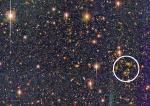
Sometimes staring into empty space is useful. Pictured above is a region of sky that was picked because it had, well, nothing: no bright stars, no bright galaxies, and no picturesque nebulas. What could not be avoided, however, were a few stars in our own Galaxy, and many distant galaxies strewn across the universe.
 The Sun Sets on Comet Hyakutake
28.04.1996
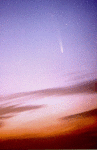
Comet Hyakutake is seen here just as the Sun sets on April 22. As April draws to a close, Comet Hyakutake will be visible only just after sunset and will be hard to discern against the brightly lit sky.
 Watch Galaxies Form
5.09.1996
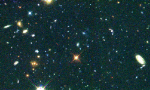
Snips and snails and puppy dog tails, is that what galaxies were made of? In a report released yesterday and soon to be published in Nature, astronomers have imaged an interesting distant patch of sky with the orbiting Hubble Space Telescope.
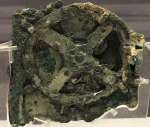 The Antikythera Mechanism
20.01.2013
What is it? It was found at the bottom of the sea aboard an ancient Greek ship. Its seeming complexity has prompted decades of study, although some of its functions remained unknown. X-ray images of the device have confirmed the nature of the Antikythera mechanism, and discovered several surprising functions.
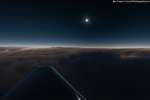 Eclipse at 44 000 Feet
7.11.2013
Timing was critical to catch this image of November 3rd's solar eclipse. But flying at 44,000 feet, intrepid eclipse chasers on a chartered jet traveling 500 miles per hour managed to intercept the the Moon's shadow. The remarkable flight made a perpendicular crossing of the central shadow track.
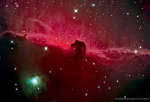 The Horsehead Nebula
31.12.2013
The Horsehead Nebula is one of the most famous nebulae on the sky. It is visible as the dark indentation to the red emission nebula in the center of the above photograph. The horse-head feature is dark because it is really an opaque dust cloud that lies in front of the bright red emission nebula.
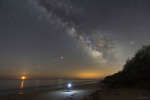 Moon, Mars, Saturn, Jupiter, Milk Way
19.05.2020
It is not a coincidence that planets line up. That's because all of the planets orbit the Sun in (nearly) a single sheet called the plane of the ecliptic. When viewed from inside that plane -- as Earth dwellers are likely to do -- the planets all appear confined to a single band.
|
January February March April May June July August September October |
|||||||||||||||||||||||||||||||||||||||||||||||||