
|
You entered: Sun
 Lunation
5.02.2012
Our Moon's appearance changes nightly. This time-lapse sequence shows what our Moon looks like during a lunation, a complete lunar cycle. As the Moon orbits the Earth, the half illuminated by the Sun first becomes increasingly visible, then decreasingly visible. The Moon always keeps the same face toward the Earth.
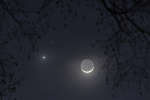 Love and War by Moonlight
25.02.2015
Venus, named for the Roman goddess of love, and Mars, the war god's namesake, came together by moonlight in this lovely skyview, recorded on February 20 from Charleston, South Carolina, USA, planet Earth.
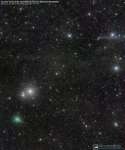 A Conjunction of Comets
23.09.2017
A conjunction of comets is captured in this pretty star field from the morning of September 17. Discovered in July by a robotic sky survey searching for supernovae, comet C/2017 O1 ASASSN is at the lower left. The visible greenish glow of its coma is produced by the fluorescence of diatomic carbon molecules in sunlight.
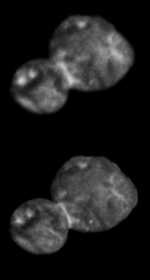 Ultima Thule Rotation Gif
4.01.2019
Ultima Thule is the most distant world explored by a spacecraft from Earth. In the dim light 6.5 billion kilometers from the Sun, the New Horizons spacecraft captured these two frames 38 minutes apart as it sped toward the Kuiper belt world on January 1 at 51,000 kilometers per hour.
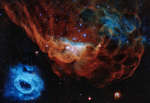 Hubble s Cosmic Reef
25.04.2020
These bright ridges of interstellar gas and dust are bathed in energetic starlight. With its sea of young stars, the massive star-forming region NGC 2014 has been dubbed the Cosmic Reef. Drifting just...
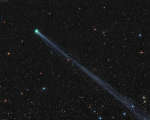 Long Tailed Comet SWAN
8.05.2020
Blowing in the solar wind the spectacular ion tail of Comet SWAN (C/2020 F8) extends far across this 10 degree wide telephoto field of view. Captured on May 2 its greenish coma was about 6 light-minutes from Earth. The pretty background starfield lies near the border of the constellations Cetus and Aquarius.
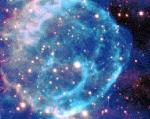 A Wolf-Rayet Star Blows Bubbles
3.01.1997
Wolf-Rayet stars can blow bubbles. These unusual stars are much hotter and more luminous than our Sun. All extremely massive stars will eventually evolve though a Wolf-Rayet phase. Approximately 200 Wolf-Rayet stars are known in our Milky Way Galaxy. Wolf-Rayet stars generate bubbles because they continually eject their outer atmosphere as a stellar wind.
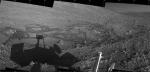 Spirit Rover at Engineering Flats on Mars
22.09.2004
Is it art? Here the paintbrush was the Spirit robotic rover, the canvas was the soil on Mars, and the artists were the scientists and engineers of the Mars Exploration Rover Mission. The picture...
 From Moonrise to Sunset
22.11.2008
In this panorama of Earth and sky recorded on Thursday, November 13, the Full Moon rises along the eastern horizon at the far left. Of course, the Full Moon rises at sunset and that Thursday's setting Sun was also captured at the far right.
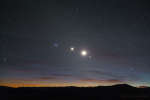 A Morning Line of Stars and Planets
11.07.2012
Early morning dog walkers got a visual treat last week as bright stars and planets appeared to line up. Pictured above, easily visible from left to right, were the Pleiades open star cluster, Jupiter, Venus, and the "Follower" star Aldebaran, all seen before a starry background.
|
January February |
|||||||||||||||||||||||||||||||||||||||||||||||||