
|
You entered: Sun
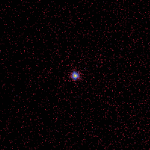 Sirius: The Brightest Star in the Night
2.09.1996
Sirius is the brightest star in the night sky. Intrinsically, Sirius is over 20 times brighter than our Sun and over twice as massive. As Sirius is 8.7 light years distant, it is not the closest star system -- the Alpha Centauri system holds this distinction.
 NGC 3242: The 'Ghost of Jupiter' Planetary Nebula
31.03.1997
It's a weed, it's Jupiter, no it's - actually planetary nebula NGC 3242. After a star like our Sun completes fusion in its core, it throws off its outer layers it a striking display called a planetary nebula.
 At the Edge of the Helix
20.07.1997
While exploring the inner edge of the Helix Nebula with the Hubble Space Telescope's Wide Field Planetary Camera 2, astronomers were able to produce this striking image - rich in details of an exotic environment.
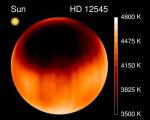 A Giant Starspot on HD 12545
2.11.2003
What could cause a star to have such a large spot? Our Sun itself frequently has sunspots, relatively cool dark magnetic depressions that move across its surface. HD 12545, however, exhibits the largest starspots yet observed.
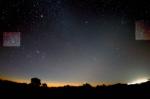 Two Comets in Southern Skies
27.05.2004
Wielding a very wide-angle lens, astronomer Gordon Garradd was able to capture two naked-eye comets in one picture looking toward the west from Loomberah, New South Wales, Australia. At the far left lies comet C/2002 T7 (LINEAR) and at the far right, comet C/2001 Q4 (NEAT).
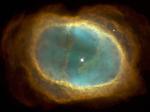 NGC 3132: The Eight Burst Nebula
14.10.2007
It's the dim star, not the bright one, near the center of NGC 3132 that created this odd but beautiful planetary nebula. Nicknamed the Eight-Burst Nebula and the Southern Ring Nebula, the glowing gas originated in the outer layers of a star like our Sun.
 Retrograde Mars
11.05.2008
Why would Mars appear to move backwards? Most of the time, the apparent motion of Mars in Earth's sky is in one direction, slow but steady in front of the far distant stars. About every two years, however, the Earth passes Mars as they orbit around the Sun.
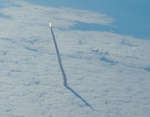 Space Shuttle Rising
25.05.2011
What's that rising from the clouds? The space shuttle. If you looked out the window of an airplane at just the right place and time last week, you could have seen something very unusual -- the space shuttle Endeavour launching to orbit.
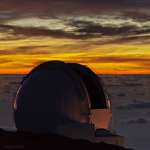 Clouds, Comet, and Crescent Moon
14.03.2013
In silhouette against the colorful evening twilight glow, clouds part in this much anticipated magic moment. The scene captures naked-eye Comet PanSTARRS peeking into northern hemisphere skies on March 12. The comet stands over the western horizon after sunset, joined by the thin, flattened crescent of a day old Moon.
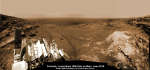 1000 Sols
13.06.2015
Shortly before Mars' June 2015 conjunction, the Curiosity Rover celebrated 1000 sols on the red planet. After its August 5, 2012 landing, Curiosity's 1000th sol or martian day on the surface corresponded to planet Earth's calendar date May 31, 2015.
|
January February |
|||||||||||||||||||||||||||||||||||||||||||||||||