
|
You entered: Sun
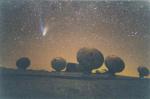 Hale-Bopp and the Plateau de Bure Interferometer
15.04.1997
Comet Hale-Bopp is being observed by many different telescopes. Here the comet is pictured behind the array of radio telescopes which compose the Plateau de Bure Interferometer. These telescopes are being used to detect the presence of different molecules in the coma and tail of Comet Hale-Bopp.
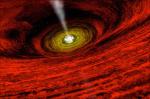 GRO J165540: Evidence for a Spinning Black Hole
25.12.2004
In the center of a swirling whirlpool of hot gas is likely a beast that has never been seen directly: a black hole. Studies of the bright light emitted by the swirling gas frequently indicate not only that a black hole is present, but also likely attributes.
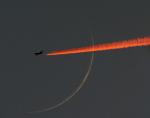 When the Moon Was Young
13.05.2005
Remember when the Moon was young? It was just last Monday. On May 9th, this slender crescent Moon was recorded at a tender age of 34 hours and 18 minutes. Well, OK ... when calculating...
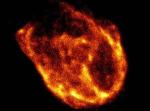 Supernova Remnant N132D in X Rays
13.09.1999
Thousands of years after a star explodes, an expanding remnant may still glow brightly. Such is the case with N132D, a supernova remnant located in the neighboring Large Magellanic Cloud galaxy. The expanding shell from this explosion now spans 80 light-years and has swept up about 600 Suns worth of mass.
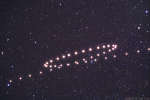 Retrograde Mars
13.06.2010
Why would Mars appear to move backwards? Most of the time, the apparent motion of Mars in Earth's sky is in one direction, slow but steady in front of the far distant stars. About every two years, however, the Earth passes Mars as they orbit around the Sun.
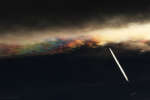 Iridescent Cloud Edge Over Colorado
28.10.2014
Sometimes your eclipse viewing goes bad in an interesting way. While watching and photographing last Thursday's partial solar eclipse, a popular astronomy blogger suffered through long periods of clouds blocking the Sun. Unexpectedly, however, a nearby cloud began to show a rare effect: iridescence.
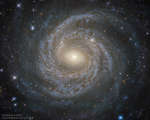 NGC 6814: Grand Design Spiral Galaxy from Hubble
20.06.2016
In the center of this serene stellar swirl is likely a harrowing black-hole beast. The surrounding swirl sweeps around billions of stars which are highlighted by the brightest and bluest. The breadth and beauty of the display give the swirl the designation of a grand design spiral galaxy.
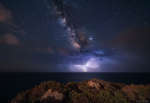 Electric Night
3.12.2019
It may appear, at first, like the Galaxy is producing the lightning, but really it's the Earth. The featured nighttime landscape was taken from a southern tip of the Italian Island of Sardinia in early June.
 A Filament in Monoceros
17.03.2022
Bluish reflection nebulae seem to fill this dusty expanse. The sharp telescopic frame spans over 1 degree on the sky toward the faint but fanciful constellation Monoceros, the Unicorn. Seen within the Monoceros...
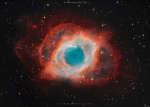 NGC 7293: The Helix Nebula
6.12.2022
A mere seven hundred light years from Earth, toward the constellation Aquarius, a sun-like star is dying. The dying star's last few thousand years have produced the Helix Nebula (NGC 7293), a well studied and nearby example of a Planetary Nebula, typical of this final phase of stellar evolution.
|
January February |
|||||||||||||||||||||||||||||||||||||||||||||||||