
|
You entered: Moon
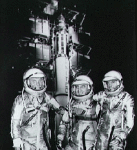 Mercury Astronauts and a Redstone
7.01.1996
Space suited project Mercury astronauts John H. Glenn, Virgil I. Grissom, and Alan B. Shepard Jr. (left to right) are pictured here posing in front of a Redstone rocket in this 1961 NASA publicity photo. Project Mercury was the first U.S. program designed to put humans in space.
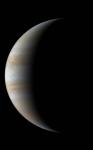 Farewell Jupiter
9.03.2003
Next stop: Saturn. The Cassini spacecraft, launched from Earth in 1997, has now swung past Jupiter and should arrive at Saturn in the year 2004. Pictured to the left is a parting shot from Cassini in January that would not have been possible from Earth: Jupiter showing a crescent phase.
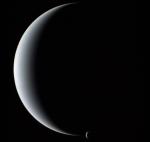 Crescent Neptune and Triton
18.06.2006
Gliding silently through the outer Solar System, the Voyager 2 spacecraft camera captured Neptune and Triton together in crescent phase in 1989. The above picture of the gas giant planet and its cloudy moon was taken from behind just after closest approach.
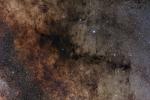 East of Antares
23.06.2006
East of Antares, dark markings seem to sprawl through the crowded star fields toward the center of our Milky Way Galaxy. Cataloged in the early 20th century by astronomer E. E. Barnard, the obscuring interstellar dust clouds include B72, B77, B78, and B59, seen in silhouette against the starry background.
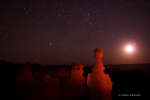 Hoodoo Sky
3.07.2008
The strange-looking rock formations in the foreground of this skyscape are called hoodoos. Towers of weathered, eroded sedimentary rock, hoodoos are found in arid regions of planet Earth and are particularly abundant in an area known as Bryce Canyon National Park in southern Utah, USA.
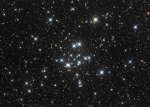 Star Cluster M34
11.02.2010
This pretty open cluster of stars, M34, is about the size of the Full Moon on the sky. Easy to appreciate in small telescopes, it lies some 1,800 light-years away in the constellation Perseus. At that distance, M34 physically spans about 15 light-years.
 Across the Sun
30.04.2015
A long solar filament stretches across the relatively calm surface of the Sun in this telescopic snap shot from April 27. The negative or inverted narrowband image was made in the light of ionized hydrogen atoms.
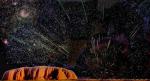 Leonids Over Ayers Rock
30.10.2002
Will this year's Leonid meteor shower be as good as last year's? No one knows for sure. Possibly, however, in the waning nighttime hours of November 18 and lasting throughout much of November 19, sky gazers across the globe may get their last chance ever to see a meteor storm.
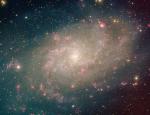 Nearby Spiral M33
2.12.2002
Spiral galaxy M33 is a mid-sized member of our Local Group of Galaxies. M33 is also called the Triangulum Galaxy for the constellation in which it resides. About four times smaller (in radius) than...
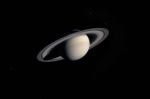 Cassini Approaches Saturn
10.12.2003
Cassini, a robot spacecraft launched in 1997 by NASA, is close enough now to resolve many rings and moons of its destination planet: Saturn. The spacecraft has now closed to within a single Earth-Sun separation from the ringed giant. Early last month, Cassini snapped the contrast-enhanced color composite pictured above.
|
January February March April May June July August September October |
|||||||||||||||||||||||||||||||||||||||||||||||||