
|
You entered: Moon
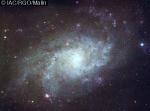 Nearby Spiral M33
21.07.1998
M33 is a prominent nearby spiral galaxy. Nicknamed the Triangulum, M33 is one of the larger members of the Local Group of Galaxies. Two massive spiral galaxies dominate the Local Group: M31 and our Milky Way Galaxy. M33 is the only other spiral galaxy known in the Local Group.
 APOD: 2006 September 27- Earth from Saturn
27.09.2006
What's that pale blue dot in this image taken from Saturn? Earth. The robotic Cassini spacecraft looked back toward its old home world earlier this month as it orbited Saturn. Using Saturn itself to block the bright Sun, Cassini imaged a faint dot on the right of the above photograph.
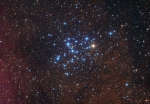 M6: The Butterfly Cluster
6.09.2011
To some, the outline of the open cluster of stars M6 resembles a butterfly. M6, also known as NGC 6405, spans about 20 light-years and lies about 2,000 light years distant.
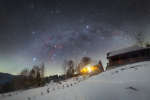 The Northern Winter Hexagon
26.12.2019
December's New Moon brought a solar eclipse to some for the holiday season. It also gave beautiful dark night skies to skygazers around the globe, like this moonless northern winter night. In the scene, bright stars of the Winter Hexagon along the Milky Way are rising.
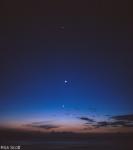 March of the Planets
25.03.1999
This March stargazers have been treated to eye-catching formations of bright planets in western evening skies. On March 3rd, looking toward a beautiful sunset from a beach on the Hawaiian isle of Maui, photographer Rick Scott recorded this fleeting, four-planet "hockey stick" array.
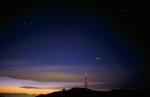 An Iridium Flash Sunset
2.05.2000
Did you see that flash? Lasting only about 15 seconds, it's possible that nobody you ask can confirm it, but what you might have seen is sunlight reflecting off an orbiting Iridium satellite. Satellites of all types have been providing streaks and glints visible only since the launch of Sputnik I in 1957.
 The Car, the Hole, and the Peekskill Meteorite
19.11.2006
The Peekskill meteor of 1992 was captured on 16 independent videos and then struck a car. Documented as brighter than the full Moon, the spectacular fireball crossed parts of several US states during its 40 seconds of glory before landing in Peekskill, New York.
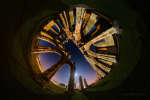 Moonset at Whitby Abbey
29.10.2016
October's Hunters Moon shines near the horizon, setting beyond the arches of Whitby Abbey in this eerie night scene. The moonlight partly illuminates the ruined Benedictine abbey's grounds and walls on a cliff overlooking the North Sea from England's Yorkshire coast.
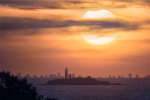 A Partial Solar Eclipse over Buenos Aires
20.02.2018
What's happened to top of the Sun? Last week, parts of Earth's southern hemisphere were treated to a partial solar eclipse, where the Moon blocks out part of the Sun. The featured image was taken toward the end of the eclipse from the coast of Uruguay overlooking Argentina's Buenos Aires.
 Sunset to Sunrise over the Baltic Sea
16.06.2023
This serene view from the coast of Sweden looks across the Baltic sea and compresses time, presenting the passage of one night in a single photograph. From sunset to sunrise, moonlight illuminates the creative sea and skyscape. Fleeting clouds, fixed stars, and flowing northern lights leave their traces in planet Earth's sky.
|
January February March April May June July August September October |
|||||||||||||||||||||||||||||||||||||||||||||||||