
|
You entered: Moon
 The Sky in Motion
31.12.2008
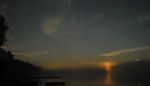
Still need to come up with a good new year's resolution? Consider one appropriate for 2009, the International Year of Astronomy; just look up -- experience, learn, and enjoy the changing sky. This 4-minute, time-lapse video is composed from a series of 7,000 images highlighting much of what you could see.
 Illuminated Cloud Trails Above Greece
15.03.2010
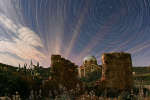
It may appear to be day, but it's night. Those wondrous orange streaks may appear to be rays from the setting Sun, but they're actually thin clouds illuminated by the Moon as they quickly streaked toward the distant horizon.
 The SONG and the Hunter
5.05.2016
Near first quarter, the Moon in March lights this snowy, rugged landscape, a view across the top of Tenerife toward La Palma in the Canary Islands Spanish archipelago. The large Teide volcano, the highest point in Spain, looms over the horizon. Shining above are familiar bright stars of Orion, the Hunter.
 Uranus: The Tilted Planet
26.08.2001
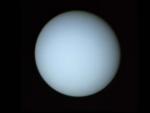
Uranus is the third largest planet in our Solar System after Jupiter and Saturn. Uranus is composed mostly of rock and ices, but with a thick hydrogen and helium atmosphere. The blue hue of Uranus' atmosphere arises from the small amount of methane which preferentially absorbs red light.
 Comet LINEAR WM1 Shines in the South
4.02.2002
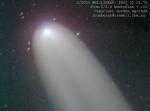
A new comet has brightened unexpectedly and is currently visible to unaided observers of southern skies. Comet C/2000 WM1 (LINEAR) is now reported by some observers to be at third magnitude, making it brighter -- although more diffuse -- than most visible stars. A dust tail as long as 3 degrees has also been reported.
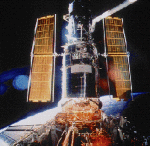 The Orbiting Hubble Space Telescope
10.08.1995
The Hubble Space Telescope (HST) is the largest orbiting public optical telescope in history. Its 2.4 meter diameter reflecting mirror and its perch above Earth's atmosphere allow it to create exceptionally sharp images.
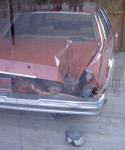 The Car, the Hole, and the Peekskill Meteorite
18.11.2002
The Peekskill meteor of 1992 was captured on 16 independent videos and then struck a car. Documented as brighter than the full Moon, the spectacular fireball crossed parts of several US states during its 40 seconds of glory before landing in Peekskill, New York.
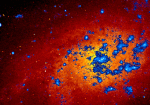 M33: The Triangulum Galaxy
8.07.1996
The spiral galaxy M33 is a mid-sized member of our Local Group of galaxies. M33 is also called the Triangulum Galaxy for the constellation in which it resides. About four times smaller (in radius)...
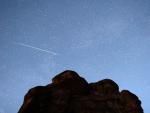 Comet Dust over Colorado
17.08.2006
The rock formation in the foreground of this night view was recorded on August 10, illuminated by light from a waning gibbous Moon. Even though the sky above also scatters the bright moonlight, a brilliant meteor was captured as it flashed across the scene during the 30 second long exposure.
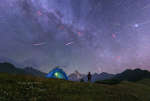 Meteors over Four Girl Mountains
13.12.2016
On some nights it rains meteors. Peaking over the next two nights, asteroid dust is expected to rain down on Earth during the annual Geminids meteor shower. This year, unfortunately, fainter Geminids will be harder to see because of the brightness of the Long Nights Full Moon, which occurs Wednesday.
|
January February March April May June July August September October |
|||||||||||||||||||||||||||||||||||||||||||||||||