
|
You entered: time
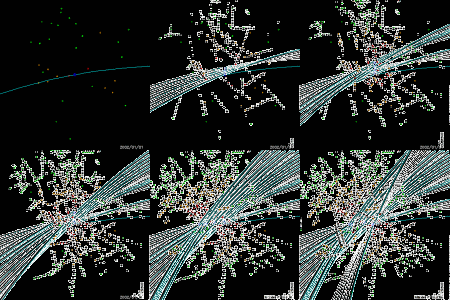 Animation of Asteroids Passing Near Earth
28.03.2006
How often does an asteroid whiz by the Earth? The above time-lapse animation follows the orbit of the Earth around the Sun for two months in 2002 as numerous asteroids, also known as minor planets, approach and pass by. Some asteroids appear out of nowhere as they are plotted only when they were discovered.
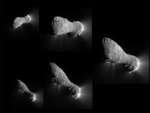 Comet Hartley 2 Flyby
5.11.2010
Follow these 5 frames clockwise starting from the top left to track the view from the EPOXI mission spacecraft as it approached, passed under, and then looked back at the nucleus of comet Hartley 2 on November 4. Its closest approach distance was about 700 kilometers.
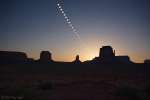 Ring of Fire over Monument Valley
9.05.2013
As the New Moon continues this season's celestial shadow play, an annular solar eclipse track begins in western Australia at 22:30 UT on May 9 -- near sunrise on May 10 local time.
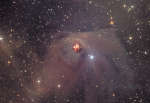 T Tauri and Hind s Variable Nebula
3.05.2014
The yellowish star near center in this dusty telescopic skyview is T Tauri, prototype of the class of T Tauri variable stars. Just next door is the yellow cosmic cloud historically known as Hind's Variable Nebula (NGC 1555).
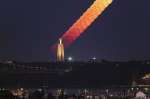 Lisbon Honey Moon
21.06.2014
The Sun set on Friday the 13th as a full Honey Moon rose, captured in this well-planned time-lapse sequence. Lisbon, Portugal's Christ the King monument is in the foreground, about 6 kilometers distant from camera and telephoto lens.
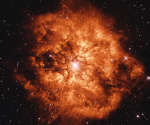 Wolf Rayet Star 124: Stellar Wind Machine
1.07.2014
Some stars explode in slow motion. Rare, massive Wolf-Rayet stars are so tumultuous and hot that they slowly disintegrating right before our telescopes. Glowing gas globs each typically over 30 times more massive than the Earth are being expelled by violent stellar winds.
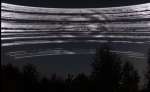 Traces of the Sun
21.12.2016
This year the December Solstice is today, December 21, at 10:44 UT, the first day of winter in the north and summer in the south. To celebrate, watch this amazing timelapse video tracing the Sun's apparent movement over an entire year from Hungary.
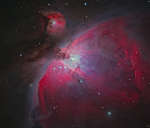 At the Heart of Orion
12.03.2017
Near the center of this sharp cosmic portrait, at the heart of the Orion Nebula, are four hot, massive stars known as the Trapezium. Tightly gathered within a region about 1.5 light-years in radius, they dominate the core of the dense Orion Nebula Star Cluster.
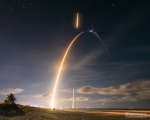 Launch and Landing
13.01.2018
A composite of three consecutive exposures, this night skyscape follows the January 7 launch and first stage landing of a Falcon 9 rocket from a beach on planet Earth's space coast. With...
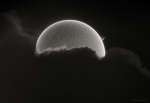 Half Sun with Prominence
2.11.2020
What's happening to the Sun? Clearly, the Sun's lower half is hidden behind a thick cloud. Averaging over the entire Earth, clouds block the Sun about 2/3rds of the time, although much less over many land locations. On the Sun's upper right is a prominence of magnetically levitating hot gas.
|
January February March April May June July August September |
|||||||||||||||||||||||||||||||||||||||||||||||||