
|
You entered: time
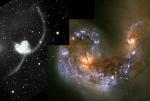 The Antennae Galaxies
22.10.1997
A ground-based telescopic view (left) of the collision between the galaxies NGC4038 and NGC4039 reveals long arcing insect-like "antennae" of luminous matter flung from the scene of the accident. Investigators using the Hubble Space...
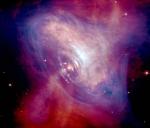 Composite Crab
4.09.2003
The Crab Pulsar, a city-sized, magnetized neutron star spinning 30 times a second, lies at the center of this composite image of the inner region of the well-known Crab Nebula. The spectacular picture combines...
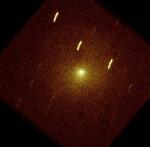 A Swift Look at Tempel 1
3.07.2005
Comet Tempel 1 is targeted for a collision with the impactor probe from NASA's Deep Impact Spacecraft at about 1:52am EDT on July 4th (other time zones). Cameras on the impactor probe...
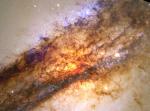 The Center of Centaurus A
17.07.2005
A fantastic jumble of young blue star clusters, gigantic glowing gas clouds, and imposing dark dust lanes surrounds the central region of the active galaxy Centaurus A. This mosaic of Hubble Space Telescope images taken in blue, green, and red light has been processed to present a natural color picture of this cosmic maelstrom.
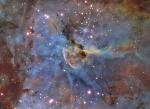 Eta and Keyhole in the Carina Nebula
16.03.2006
South is toward the top in this colorful close-up view of the Great Carina Nebula (NGC 3372), famous star-forming region of the southern sky. Covering an area surrounding the dusty Keyhole Nebula (NGC 3324)...
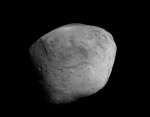 Comet Tempel 1 from Stardust NeXT Spacecraft
16.02.2011
No comet has ever been visited twice before. Therefore, the unprecedented pass of the Stardust-NeXT spacecraft near Comet Tempel 1 earlier this week gave humanity a unique opportunity to see how the nucleus of a comet changes over time.
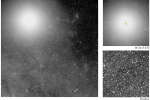 Alpha Centauri: The Closest Star System
3.07.2011
The closest star system to the Sun is the Alpha Centauri system. Of the three stars in the system, the dimmest -- called Proxima Centauri -- is actually the nearest star. The bright stars Alpha Centauri...
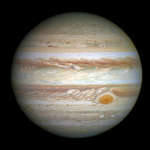 Hubble s Jupiter and Shrinking Great Red Spot
17.05.2014
Gas giant Jupiter is the solar system's largest world with about 320 times the mass of planet Earth. It's also known for a giant swirling storm system, the Great Red Spot, featured in this sharp Hubble image from April 21.
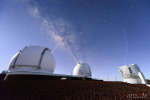 Four Lasers over Mauna Kea
23.06.2014
Are lasers from giant telescopes being used to attack the Galactic center? No. Lasers shot from telescopes are now commonly used to help increase the accuracy of astronomical observations. In some sky locations, Earth...
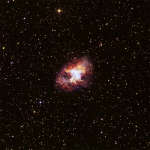 Cosmic Crab Nebula
25.07.2014
The Crab Pulsar, a city-sized, magnetized neutron star spinning 30 times a second, lies at the center of this tantalizing wide-field image of the Crab Nebula. A spectacular picture of one of our Milky Way's supernova remnants, it combines optical survey data with X-ray data from the orbiting Chandra Observatory.
|
January February March April May June July August September |
|||||||||||||||||||||||||||||||||||||||||||||||||