
|
You entered: time
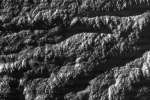 Seventeen Hundred Kilometers Above Enceladus
5.11.2008
Above is one of the closest pictures yet obtained of Saturn's ice-spewing moon Enceladus. The image was taken from about 1,700 kilometers up as the robotic Cassini spacecraft zoomed by the fractured ice ball last week.
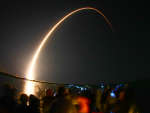 Kepler s Streak
9.03.2009
Streaking skyward, a Delta II rocket carries NASA's Kepler spacecraft aloft into the clear night of March 6. The dramatic scene was recorded in a time exposure from the crowded pier in Jetty Park at the northern end of Cocoa Beach, Florida, about 3 miles from the Cape Canaveral launch site.
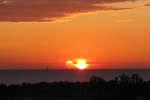 A Triple Sunrise Over Gdansk Bay
4.08.2009
How can the same Sun rise three times? Last month on Friday, 2009 July 10, a spectacular triple sunrise was photographed at about 4:30 am over Gdansk Bay in Gdansk, Poland. Clearly, our Sun rises only once. Some optical effect is creating at least two mirages of the Sun -- but which effect?
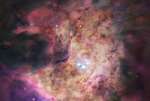 At the Heart of Orion
6.10.2012
Near the center of this sharp cosmic portrait, at the heart of the Orion Nebula, are four hot, massive stars known as the Trapezium. Gathered within a region about 1.5 light-years in radius, they dominate the core of the dense Orion Nebula Star Cluster.
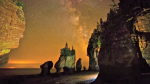 Mysterious Green Patches on the Sky
30.09.2013
What is it? Some surely natural phenomenon has appeared in a video that, so far, has defied clear identification. The above time-lapse video was made to record Perseid meteors above Hopewell Rocks in New Brunswick, Canada late this summer.
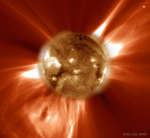 Sun Storm: A Coronal Mass Ejection
10.01.2016
What's happening to our Sun? Another Coronal Mass Ejection (CME)! The Sun-orbiting SOHO spacecraft has imaged many erupting filaments lifting off the active solar surface and blasting enormous bubbles of magnetic plasma into space.
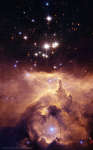 NGC 6357: Cathedral to Massive Stars
27.03.2016
How massive can a normal star be? Estimates made from distance, brightness and standard solar models had given one star in the open cluster Pismis 24 over 200 times the mass of our Sun, making it one of the most massive stars known.
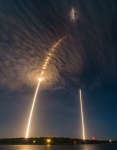 Falcon 9: Launch and Landing
21.07.2016
Shortly after midnight on July 18 a SpaceX Falcon 9 rocket launched from Space Launch Complex 40 at Cape Canaveral Air Force Station, Florida, planet Earth. About 9 minutes later, the rocket's first stage returned to the spaceport.
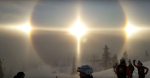 Sun Halo over Sweden
1.01.2018
What's happened to the Sun? Sometimes it looks like the Sun is being viewed through a giant lens. In the featured video, however, there are actually millions of tiny lenses: ice crystals. Water may freeze in the atmosphere into small, flat, six-sided, ice crystals.
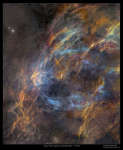 Cygnus Shell Supernova Remnant W63
2.11.2018
The ghost of a long-dead star, the W63 supernova remnant shines like a faint cosmic smoke-ring along the plane of the Milky Way galaxy toward the northern constellation Cygnus the swan. Its wraithlike appearance is traced against the region's rich complex of interstellar clouds and dust by an eerie blue glow.
|
January February March April May June July August September |
|||||||||||||||||||||||||||||||||||||||||||||||||