
|
You entered: motion
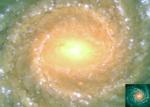 Spiral Galaxy NGC 1232
30.09.1998
Galaxies are fascinating not only for what is visible, but for what is invisible. Grand spiral galaxy NGC 1232, recently captured in detail by the new Very Large Telescope, is a good example.
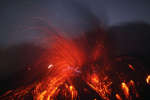 Sakurajima Volcano with Lightning
9.02.2010
Why does a volcanic eruption sometimes create lightning? Pictured above, the Sakurajima volcano in southern Japan was caught erupting early last month. Magma bubbles so hot they glow shoot away as liquid rock bursts through the Earth's surface from below.
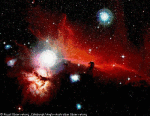 Orion's Horsehead Nebula
2.10.1996
The Horsehead Nebula is arguably the most famous nebula on the sky. It is visible as the black indentation to the red emission nebula seen just to the right of center of the above photograph. The bright star near the center is located in the belt of the familiar constellation of Orion.
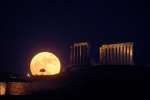 Solstice Moonrise, Cape Sounion
20.06.2008
Today's solstice marks the northernmost point of the Sun's annual motion through planet Earth's sky and the astronomical beginning of the northern hemisphere's summer. But only two days ago, the Full Moon nearest the solstice rose close to the ecliptic plane opposite the Sun, near its southernmost point for the year.
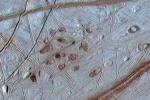 Europa s Freckles
31.10.2002
Europa, one of Jupiter's large Galilean moons, may well posses an ocean of liquid water hidden beneath its icy surface -- and so holds the tantalizing possibility of life. In this image, constructed with...
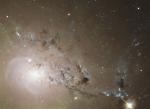 NGC 1275: A Galactic Collision
5.05.2003
In NGC 1275, one galaxy is slicing through another. The disk of the dusty spiral galaxy near the image center is cutting through a large elliptical galaxy, visible predominantly on the lower left. Galaxies...
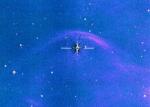 Runaway Star
26.11.1999
Runaway stars are massive stars traveling rapidly through interstellar space. Like a ship plowing through the interstellar medium, runaway star HD 77581 has produced this graceful arcing bow wave or "bow shock" - compressing the gaseous material in its path.
 NGC 4676: When Mice Collide
3.10.2021
These two mighty galaxies are pulling each other apart. Known as the "Mice" because they have such long tails, each spiral galaxy has likely already passed through the other. The long tails are created by the relative difference between gravitational pulls on the near and far parts of each galaxy.
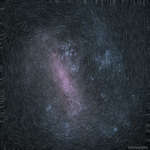 Rotation of the Large Magellanic Cloud
15.05.2018
This image is not blurry. It shows in clear detail that the largest satellite galaxy to our Milky Way, the Large Cloud of Magellan (LMC), rotates. First determined with Hubble, the rotation of the LMC is presented here with fine data from the Sun-orbiting Gaia satellite.
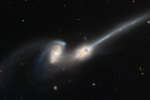 NGC 4676: When Mice Collide
26.04.2009
These two mighty galaxies are pulling each other apart. Known as "The Mice" because they have such long tails, each spiral galaxy has likely already passed through the other. They will probably collide again and again until they coalesce.
|
January February March April May June July August September |
|||||||||||||||||||||||||||||||||||||||||||||||||