
|
You entered: motion
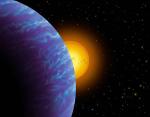 The Decade that Defined Star System
29.12.1999
As the 1990s began, the only planetary star system known was our own Solar System. The first extra-solar star system was discovered orbiting a pulsar in 1991. Slight changes in the precise arrival times of the pulses from the central small dense neutron star gave evidence of orbiting planets.
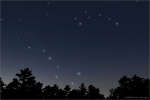 The Big Dipper
21.04.2013
Do you see it? This common question frequently precedes the rediscovery of one of the most commonly recognized configurations of stars on the northern sky: the Big Dipper. This grouping of stars is one of the few things that has likely been seen, and will be seen, by every generation.
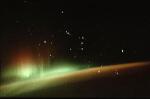 Aurora and Orion
26.01.1997
Looking toward the south from low Earth orbit, the crew of the Space Shuttle Endeavor made this stunning time exposure of the Aurora Australis or southern lights in April of 1994. Aurora are visible at high northern latitudes as well, with the northern lights known as Aurora Borealis.
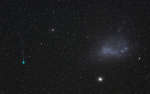 Sweeping Through Southern Skies
16.02.2013
For now, Comet Lemmon (C/2012 F6a), and Comet PanSTARRS (C/2011 L4) are sweeping through southern skies. Lemmon's lime green coma and thin tail are near the left edge of this telephoto scene, a single frame from a timelapse video (vimeo here) recorded on February 12, tracking its motion against the background stars.
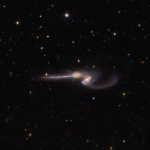 NGC 4676: The Mighty Mice
14.06.2019
These two mighty galaxies are pulling each other apart. Known as The Mice because they have such long tails, each large spiral galaxy has actually passed through the other. Their long tails are drawn out by strong gravitational tides rather than collisions of their individual stars.
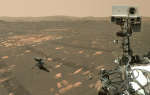 Perseverance Selfie with Ingenuity
1.07.2021
On sol 46 (April 6, 2021) the Perseverance rover held out a robotic arm to take its first selfie on Mars. The WATSON camera at the end of the arm was designed to take close-ups of martian rocks and surface details though, and not a quick snap shot of friends and smiling faces.
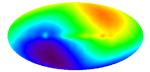 CMB Dipole: Speeding Through the Universe
28.01.2001
Our Earth is not at rest. The Earth moves around the Sun. The Sun orbits the center of the Milky Way Galaxy. The Milky Way Galaxy orbits in the Local Group of Galaxies. The Local Group falls toward the Virgo Cluster of Galaxies.
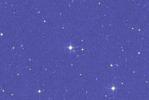 A Planet For Gliese 876
26.06.1998
Centered in this unremarkable, 1/4 degree wide patch of sky in the constellation Aquarius is the star Gliese 876. Gliese 876 is smaller than the Sun, only about 1/3 as massive, and too faint to be seen without a telescope. But it is known to be one of the nearest stars, only 15 light-years distant.
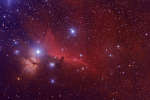 Orion s Horsehead Nebula
21.02.2008
The Horsehead Nebula is one of the most famous nebulae on the sky. It is visible as the dark indentation to the red emission nebula seen just below and left of center in the this photograph. The brightest star on the left is located in the belt of the familiar constellation Orion.
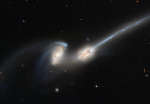 NGC 4676: When Mice Collide
31.01.2015
These two mighty galaxies are pulling each other apart. Known as the "Mice" because they have such long tails, each spiral galaxy has likely already passed through the other. The long tails are created by the relative difference between gravitational pulls on the near and far parts of each galaxy.
|
January February March April May June July August September |
|||||||||||||||||||||||||||||||||||||||||||||||||