
|
You entered: motion
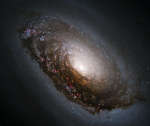 M64: The Sleeping Beauty Galaxy
12.06.2011
The Sleeping Beauty galaxy may appear peaceful at first sight but it is actually tossing and turning. In an unexpected twist, recent observations have shown that the gas in the outer regions of this photogenic spiral is rotating in the opposite direction from all of the stars!
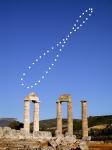 Analemma Over Ancient Nemea
21.06.2004
An anelemma is that figure-8 curve that you get when you mark the position of the Sun at the same time each day throughout planet Earth's year. Above, 44 separate exposures (plus...
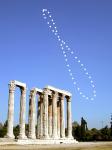 The Analemma and the Temple of Olympian Zeus
23.12.2006
An analemma is that figure-8 curve you get when you mark the position of the Sun at the same time each day throughout planet Earth's year. Above, 47 separate exposures (plus one foreground...
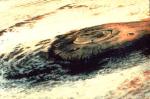 Olympus Mons on Mars: The Largest Volcano
15.09.1997
The largest volcano in the Solar System is on Mars. Olympus Mons rises 24 kilometers high and measures 550 km across. By comparison, Earth's largest volcano, Mauna Loa in Hawaii, rises 9 km high and measures 120 km across.
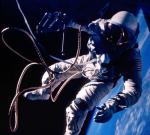 First US Spacewalk
4.06.2005
In 1965, forty years ago on June 3rd, astronaut Edward White made the first U.S. spacewalk. Tethered to his Gemini IV capsule, White is pictured above holding a compressed gas "zip gun" for maneuvers in his right hand.
 The Big Dipper Cluster
17.03.2006
A well-known asterism in northern skies, The Big Dipper is easy to recognize even when viewed upside down. Part of the larger constellation of Ursa Major, the bright dipper stars above are named (left to right along the dipper) Dubhe, Merak, Phecda, Megrez, Alioth, Mizar/Alcor, and Alkaid.
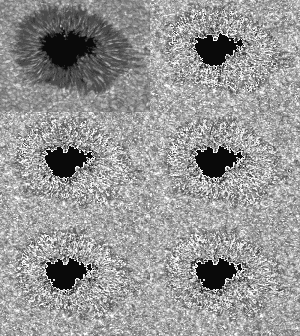 Sunspot Seething
23.02.2000
Our Sun's surface is continually changing. This time-lapse movie shows in five seconds what happens in 20 minutes on the Sun's surface near a sunspot. Visible is boiling granulation outside the sunspot...
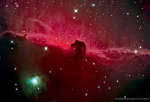 The Horsehead Nebula
31.12.2013
The Horsehead Nebula is one of the most famous nebulae on the sky. It is visible as the dark indentation to the red emission nebula in the center of the above photograph. The horse-head feature is dark because it is really an opaque dust cloud that lies in front of the bright red emission nebula.
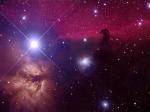 Orions Horsehead Nebula
29.01.2003
The Horsehead Nebula is one of the most famous nebulae on the sky. It is visible as the dark indentation to the red emission nebula seen above and to the right of center in the above photograph. The bright star on the left is located in the belt of the familiar constellation of Orion.
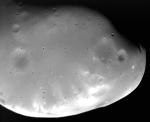 Deimos: A Small Martian Moon
4.01.2004
Mars has two tiny moons, Phobos and Deimos. Pictured above is Deimos, the smaller moon of Mars. In fact, Deimos is one of the smallest known moons in the Solar System measuring only nine miles across.
|
January February March April May June July August September |
|||||||||||||||||||||||||||||||||||||||||||||||||