
|
You entered: motion
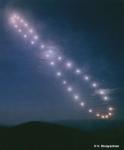 Analemma over the Ukraine
17.06.2007
If you took a picture of the Sun at the same time each day, would it remain in the same position? The answer is no, and the shape traced out by the Sun over the course of a year is called an analemma.
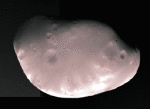 Deimos: Small Martian Moon
3.10.1995
Mars has two tiny moons, Phobos and Deimos. Pictured above is Deimos, the smallest moon of Mars. In fact, Deimos is the smallest known moon in the Solar System measuring only 9 miles across.
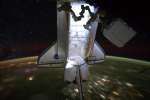 Endeavour s Starry Night
2.06.2011
This luminous night view of the space shuttle orbiter Endeavour, docked with the International Space Station for a final time, was captured on May 28. Orbiting 350 kilometers above planet Earth, Endeavour's payload bay is lit up as it hurtles through Earth's shadow at 27,000 miles per hour.
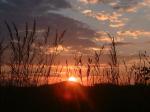 Zimbabwe Sunset
21.06.2002
Today's scheduled geocentric astronomical event is the Solstice, with the Sun reaching its northernmost declination at 13 hours 24 minutes Universal Time. For denizens of planet Earth this Solstice marks the begining of Summer in the northern hemisphere and Winter in the south.
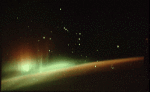 Aurora and Orion
14.11.1995
Looking toward the south from low Earth orbit, the crew of the Space Shuttle Endeavor made this stunning time exposure of the Aurora Australis (southern lights) in April of 1994. The aurora are caused by high energy electrons from the Solar Wind which are funneled into the atmosphere by the Earth's magnetic field.
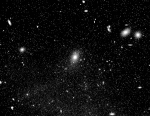 The Virgo Cluster of Galaxies
20.02.2000
Pictured are several galaxies of the Virgo Cluster, the closest cluster of galaxies to our Milky Way Galaxy. The Virgo Cluster spans more than 5 degrees on the sky - about 10 times the angle made by a full Moon. It contains over 100 galaxies of many types - including spirals, ellipticals, and irregular galaxies.
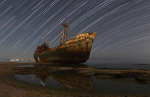 Star Trails and the Captain s Ghost
29.10.2010
Look closely at this surreal nightscape. In the dreamlike scene, star trails arc over an old ship run aground on a beach near Gytheio, Peloponnesus in southern Greece. Could that be the captain's ghost haunting the beach, gazing forlornly at the decaying wreck, hovering over starlight reflected in still water?
 COBE Dipole: Speeding Through the Universe
9.02.2003
Our Earth is not at rest. The Earth moves around the Sun. The Sun orbits the center of the Milky Way Galaxy. The Milky Way Galaxy orbits in the Local Group of Galaxies. The Local Group falls toward the Virgo Cluster of Galaxies.
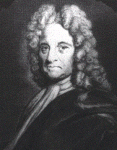 Edmund Halley's Greatest Discoveries
6.07.1996
Sir Edmond Halley was quite a discoverer. Born in 1656, he computed in 1705 that a bright comet was periodic and would make another appearance in 1758. The comet appeared as predicted and is now known as Comet Halley. Unfortunately, Halley died in 1742 and never saw his prediction come true.
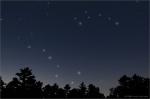 The Big Dipper
8.01.2007
Do you see it? This common question frequently precedes the rediscovery of one of the most commonly recognized configurations of stars on the northern sky: the Big Dipper. This grouping of stars is one of the few things that has likely been seen, and will be seen, by every generation.
|
January February March April May June July August September |
|||||||||||||||||||||||||||||||||||||||||||||||||