
|
You entered: motion
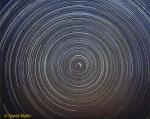 Star Trails in Northern Skies
30.11.1996
As the Earth spins on its axis, the sky seems to rotate around us. This motion produces the beautiful concentric arcs traced out by the stars in this time exposure of the night sky.
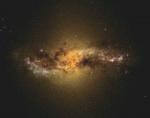 Arp 230: Two Spirals in One?
31.08.1997
Is this one galaxy or two? Analysis of Arp 230 has shown evidence that this seemingly single spiral galaxy is actually the result of the recent collision of two spiral galaxies. The slow motion collision took place over about 100 million years and induced a burst of star formation that has begun to subside.
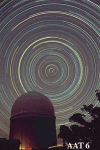 Star Trails in Southern Skies
25.09.1995
As the Earth spins on its axis, the sky seems to rotate around us. This motion produces the beautiful concentric arcs traced out by the stars in this time exposure of the night sky. In the foreground of the picture is the dome of the Anglo-Australian Telescope in central New South Wales Australia.
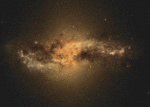 Arp 230: Two Spirals in One?
22.08.1996
Is this one galaxy or two? Analysis of Arp 230 has shown evidence that this seemingly single spiral galaxy is actually the result of the recent collision of two spiral galaxies. The slow motion collision took place over about 100 million years and induced a burst of star formation that has begun to subside.
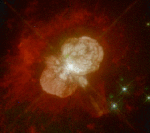 Eta Carinae Before Explosion
12.07.1995
The star Eta Carinae, at the center of the photo, will likely destroy itself in a spectacular explosion in a few million years - or sooner! Currently it is one of the brightest, most massive, and least stable stars known. Much of the gas in this Hubble Space Telescope photograph was blown off the star itself.
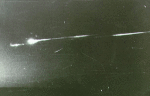 A Meteoric View of Apollo 13
9.07.1995
Meteors, also called shooting stars, normally begin as bits of dust from the tails of comets or even small pieces chipped off asteroids. Falling toward Earth, these particles enter the atmosphere at extremely high speeds. Friction with the air heats them up and makes them glow brightly.
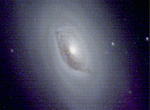 M64: The Sleeping Beauty Galaxy
11.07.1998
The Sleeping Beauty galaxy may appear peaceful at first sight but it is actually tossing and turning. In an unexpected twist, recent observations have shown that the center of this photogenic galaxy is rotating in the opposite direction than the outer regions!
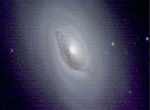 M64: The Sleeping Beauty Galaxy
21.03.1997
The Sleeping Beauty galaxy may appear peaceful at first sight but it is actually tossing and turning. In an unexpected twist, recent observations have shown that the center of this photogenic galaxy is rotating in the opposite direction than the outer regions!
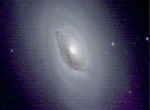 M64: The Sleeping Beauty Galaxy
14.12.1995
The Sleeping Beauty galaxy may appear peaceful at first sight but it is actually tossing and turning. In an unexpected twist, recent observations have shown that the center of this photogenic galaxy is rotating in the opposite direction than the outer regions!
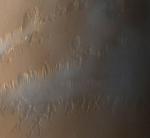 Mars: A Mist In Mariner Valley
17.10.1997
An icy mist and late afternoon clouds cover much of this section of Valles Marineris on Mars. The Valles Marineris or Mariner Valley is a huge canyon system about 2,000 miles long and up to 5 miles deep.
|
January February March April May June July August September |
|||||||||||||||||||||||||||||||||||||||||||||||||