
|
You entered: apod
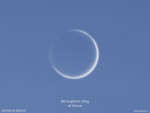 Atmospheric Ring of Venus
8.06.2020
Why is Venus surrounded by a bright ring? Sometimes called a ring of fire, this rare ring is caused by the Sun's light being visible all around an object. Usually seen around...
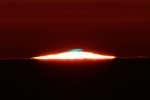 A Green Flash from the Sun
4.01.2011
Many think it is just a myth. Others think it is true but its cause isn't known. Adventurers pride themselves on having seen it. It's a green flash from the Sun. The truth is the green flash does exist and its cause is well understood.
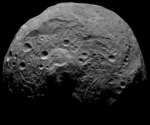 Vesta Vista
19.07.2011
What does the surface of asteroid Vesta look like? The brightest asteroid in the Solar System and the object which takes up about 10 percent of the entire mass of the main asteroid belt had never been seen up close before.
 Moon and Planets Over Catalonia
29.02.2012
Venus and Jupiter will appear unusually close in the sky over the next month. The planetary conjunction will be easily visible to the unaided eye because Venus will appear brighter than any background star, and Jupiter will be nearly as bright. To see the near-alignment, simply look to the west after sunset.
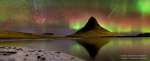 Meteors and Aurorae over Iceland
7.08.2013
What's going on behind that volcano? Quite a bit. First of all, the volcano itself, named Kirkjufell, is quite old and located in western Iceland near the town of GrundarfjЖrПur. In front...
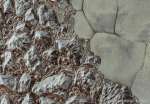 Pluto: From Mountains to Plains
14.12.2015
What do the sharpest views ever of Pluto show? As the robotic New Horizons spacecraft moves into the outer Solar System, it is now sending back some of the highest resolution images from its historic encounter with Pluto in July. Featured here is one recently-received, high-resolution image.
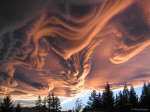 Asperatus Clouds Over New Zealand
17.04.2016
What kind of clouds are these? Although their cause is presently unknown, such unusual atmospheric structures, as menacing as they might seem, do not appear to be harbingers of meteorological doom. Known informally...
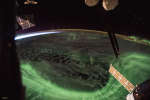 The Aurora and the Sunrise
1.05.2018
On the International Space Station (ISS), you can only admire an aurora until the sun rises. Then the background Earth becomes too bright. Unfortunately, after sunset, the rapid orbit of the ISS around the Earth means that sunrise is usually less than 47 minutes away.
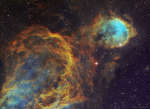 WR32 and Interstellar Clouds in Carina
8.02.2021
Stars can be like artists. With interstellar gas as a canvas, a massive and tumultuous Wolf-Rayet star has created the picturesque ruffled half-circular filaments called WR32, on the image left. Additionally, the winds...
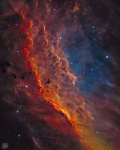 NGC 1499: The California Nebula
10.03.2021
Could Queen Calafia's mythical island exist in space? Perhaps not, but by chance the outline of this molecular space cloud echoes the outline of the state of California, USA. Our Sun has its home within the Milky Way's Orion Arm, only about 1,000 light-years from the California Nebula.
|
January February March April May June July August September |
|||||||||||||||||||||||||||||||||||||||||||||||||