
|
You entered: apod
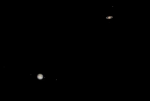 Jupiter and Saturn Great Conjunction: The Movie
30.12.2020
Yes, but have you seen a movie of Jupiter and Saturn's Great Conjunction? The featured time-lapse video was composed from a series of images taken from Thailand and shows the two giant planets as they angularly passed about a tenth of a degree from each other.
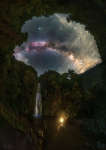 A Waterfall and the Milky Way
1.11.2021
The dream was to capture both the waterfall and the Milky Way together. Difficulties included finding a good camera location, artificially illuminating the waterfall and the surrounding valley effectively, capturing the entire scene with...
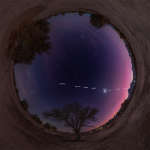 Solar System Family Portrait
29.06.2022
Yes, but have you ever seen all of the planets at once? A rare roll-call of planets has been occurring in the morning sky for much of June. The featured fisheye all-sky image, taken...
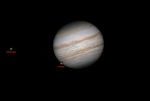 Jupiter Rotates as Moons Orbit
25.10.2022
Jupiter and its moons move like our Sun and its planets. Similarly, Jupiter spins while its moons circle around. JupiterБs rotation can be observed by tracking circulating dark belts and light zones. The Great Red Spot, the largest storm known, rotates to become visible after about 15 seconds in the 48-second time lapse video.
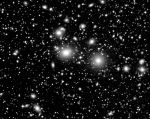 The Perseus Cluster of Galaxies
5.04.1996
Here is one of the largest objects that anyone will ever see on the sky. Each of the fuzzy blobs in the above picture is a galaxy, together making up the Perseus Cluster, one of the closest clusters of galaxies.
 Moonrise Over Turkey
16.06.2009
Is the Moon larger when near the horizon? No -- as shown above, the Moon appears to be very nearly the same size no matter its location on the sky. Oddly, the cause or causes for the common Moon Illusion are still being debated.
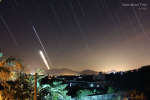 A Fading Moonset Over Hong Kong
15.12.2009
Do stars appear dimmer when nearer the horizon? Yes -- atmospheric air absorbs and reradiates light, so that the greater the airmass through which one peers, the fainter an object will appear. Pictured above in a multi-frame image, stars, the planet Jupiter, and even the Moon show the horizon-dimming effects of Earth's nearly-transparent atmosphere.
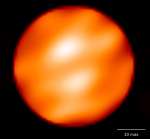 The Spotty Surface of Betelgeuse
6.01.2010
Betelgeuse really is a big star. If placed at the center of our Solar System it would extend to the orbit of Jupiter. But like all stars except the Sun, Betelgeuse is so distant it usually appears as a single point of light, even in large telescopes.
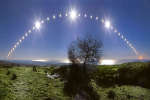 Tyrrhenian Sea and Solstice Sky
21.12.2010
Today the solstice occurs at 23:38 Universal Time, the Sun reaching its southernmost declination in planet Earth's sky. Of course, the December solstice marks the beginning of winter in the northern hemisphere and summer in the south.
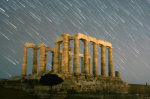 Celestial Trails over Greece
4.05.2011
If you watch the horizon at just the right place and at just the right time, you can witness some spectacular juxtapositions between Earth and sky. In the above video, stars, the Moon, and even a partially eclipsed Sun were recorded rising and setting over photogenic landmarks in Greece.
|
January February March April May June July August September |
|||||||||||||||||||||||||||||||||||||||||||||||||