
|
You entered: apod
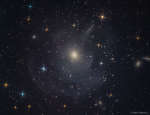 M89: Elliptical Galaxy with Outer Shells and Plumes
14.06.2017
Can you see them? This famous Messier object M89, a seemingly simple elliptical galaxy, is surrounded by faint shells and plumes. The cause of the shells is currently unknown, but possibly tidal tails related to debris left over from absorbing numerous small galaxies in the past billion years.
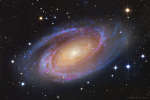 Bright Spiral Galaxy M81
17.09.2017
One of the brightest galaxies in planet Earth's sky is similar in size to our Milky Way Galaxy: big, beautiful M81. This grand spiral galaxy can be found toward the northern constellation of the Great Bear (Ursa Major).
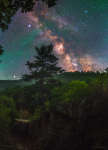 Firefly Milky Way over Russia
6.09.2021
It started with a pine tree. The idea was to photograph a statuesque pine in front of the central band of our Milky Way Galaxy. And the plan, carried out two months ago, was successful -- they both appear prominently. But the resulting 3-frame panorama captured much more.
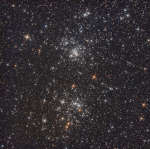 The Double Cluster in Perseus
8.10.2021
This pretty starfield spans about three full moons (1.5 degrees) across the heroic northern constellation of Perseus. It holds the famous pair of open star clusters, h and Chi Persei. Also cataloged...
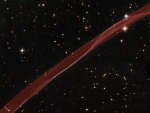 SN 1006: A Supernova Ribbon from Hubble
15.09.2008
What created this unusual space ribbon? Most assuredly, one of the most violent explosions ever witnessed by ancient humans. Back in the year 1006 AD, light reached Earth from a stellar explosion...
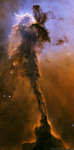 The Fairy of Eagle Nebula
2.12.2018
The dust sculptures of the Eagle Nebula are evaporating. As powerful starlight whittles away these cool cosmic mountains, the statuesque pillars that remain might be imagined as mythical beasts. Featured here is one of several striking dust pillars of the Eagle Nebula that might be described as a gigantic alien fairy.
 A Volcano of Fire under a Milky Way of Stars
27.05.2019
Sometimes it's hard to decide which is more impressive -- the land or the sky. On the land of the featured image, for example, the Volcano of Fire (VolcАn de Fuego) is seen erupting topped by red-hot, wind-blown ash and with streams of glowing lava running down its side.
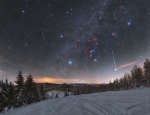 Quadrantid Meteors through Orion
20.01.2020
Why are these meteor trails nearly parallel? Because they were all shed by the same space rock and so can be traced back to the same direction on the sky: the radiant of the Quadrantid Meteor Shower.
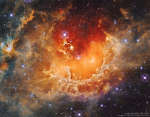 Star Formation in the Tadpole Nebula
28.01.2020
What's all of the commotion in the Tadpole Nebula? Star formation. Dusty emission in the Tadpole Nebula, IC 410, lies about 12,000 light-years away in the northern constellation of the Charioteer (Auriga).
 Star Trails of the North and South
12.02.2020
What divides the north from the south? It all has to do with the spin of the Earth. On Earth's surface, the equator is the dividing line, but on Earth's sky, the dividing line is the Celestial Equator -- the equator's projection onto the sky.
|
January February March April May June July August September |
|||||||||||||||||||||||||||||||||||||||||||||||||