
|
You entered: apod
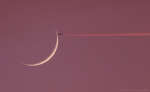 Fly Me to the Moon
17.01.2017
No, this is not a good way to get to the Moon. What is pictured is a chance superposition of an airplane and the Moon. The contrail would normally appear white, but the large volume of air toward the setting Sun preferentially knocks away blue light, giving the reflected trail a bright red hue.
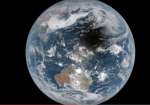 Moon Shadow versus Sun Reflection
17.07.2017
What are those lights and shadows crossing the Earth? As the featured five-second time-lapse video progresses, a full day on planet Earth is depicted as seen from Japan's Himawari-8 satellite in geostationary orbit high above the Pacific Ocean.
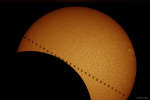 A Fleeting Double Eclipse of the Sun
28.08.2017
Last week, for a fraction of a second, the Sun was eclipsed twice. One week ago today, many people in North America were treated to a standard, single, partial solar eclipse. Fewer people, all congregated along a narrow path, experienced the eerie daytime darkness of a total solar eclipse.
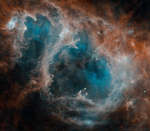 The Soul Nebula in Infrared from Herschel
4.10.2017
Stars are forming in the Soul of the Queen of Aethopia. More specifically, a large star forming region called the Soul Nebula can be found in the direction of the constellation Cassiopeia, who Greek mythology credits as the vain wife of a King who long ago ruled lands surrounding the upper Nile river.
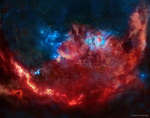 Orion in Red and Blue
14.10.2018
When did Orion become so flashy? This colorful rendition of part of the constellation of Orion comes from red light emitted by hydrogen and sulfur (SII), and blue-green light emitted by oxygen (OIII). Hues...
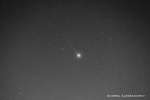 Mercurys Sodium Tail
8.07.2020
What is that fuzzy streak extending from Mercury? Long exposures of our Solar System's innermost planet may reveal something unexpected: a tail. Mercury's thin atmosphere contains small amounts of sodium that glow when excited by light from the Sun. Sunlight also liberates these molecules from Mercury's surface and pushes them away.
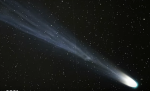 Video: Comet Leonard over One Hour
25.01.2022
Which direction is this comet heading? Judging by the tail, one might imagine that Comet Leonard is traveling towards the bottom right, but a full 3D analysis shows it traveling almost directly away from the camera.
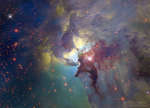 The Lively Center of the Lagoon Nebula
25.05.2022
The center of the Lagoon Nebula is a whirlwind of spectacular star formation. Visible near the image center, at least two long funnel-shaped clouds, each roughly half a light-year long, have been formed by extreme stellar winds and intense energetic starlight. A tremendously bright nearby star, Herschel 36, lights the area.
 Crepuscular Moon Rays over Denmark
27.07.2022
This moon made quite an entrance. Typically, a moonrise is quiet and serene. Taking a few minutes to fully peek above the horizon, Earth's largest orbital companion can remain relatively obscure until it rises high in the nighttime sky.
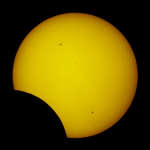 Eclipsing the Sun
5.01.2011
Skywatchers throughout much of Europe, North Africa, and Central Asia, were treated to the first eclipse of the new year on January 4, a partial eclipse of the Sun. But traveling to the area...
|
January February March April May June July August September |
|||||||||||||||||||||||||||||||||||||||||||||||||