
|
You entered: apod
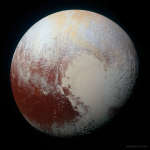 Pluto in Enhanced Color
1.08.2021
Pluto is more colorful than we can see. Color data and high-resolution images of our Solar System's most famous dwarf planet, taken by the robotic New Horizons spacecraft during its flyby in 2015 July, have been digitally combined to give an enhanced-color view of this ancient world sporting an unexpectedly young surface.
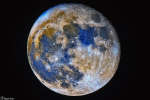 A Blue Moon in Exaggerated Colors
31.08.2021
The Moon is normally seen in subtle shades of grey or gold. But small, measurable color differences have been greatly exaggerated to make this telescopic, multicolored, moonscape captured during the Moon's full phase. The different colors are recognized to correspond to real differences in the chemical makeup of the lunar surface.
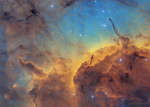 Stars, Dust, Pillars, and Jets in the Pelican Nebula
11.10.2022
What dark structures arise within the Pelican Nebula? On the whole, the nebula appears like a bird (a pelican) and is seen toward the constellation of a different bird: Cygnus, a Swan. But inside, the Pelican Nebula is a place lit up by new stars and befouled by dark dust.
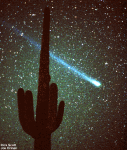 Comet Hyakutake and a Cactus
1.05.1996
Comet Hyakutake is shown photographed the night of March 27 in Arizona, USA, with a cactus in the foreground. Polaris, the north star, is the bright star seen just to the upper right of the comet's head. Today Comet Hyakutake reaches its closest approach to the Sun.
 Saturns Hexagon Comes to Light
22.01.2012
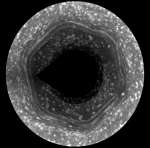
Believe it or not, this is the North Pole of Saturn. It is unclear how an unusual hexagonal cloud system that surrounds Saturn's north pole was created, keeps its shape, or how long it will last.
 Phobos: Doomed Moon of Mars
22.11.2015
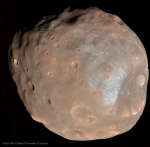
This moon is doomed. Mars, the red planet named for the Roman god of war, has two tiny moons, Phobos and Deimos, whose names are derived from the Greek for Fear and Panic. These...
 Earthset from the Lunar Reconnaissance Orbiter
4.01.2016
On the Moon, the Earth never rises -- or sets. If you were to sit on the surface of the Moon, you would see the Earth just hang in the sky. This is because the Moon always keeps the same side toward the Earth.
 Aurora Over White Dome Geyser
2.10.2016
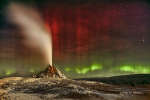
Sometimes both heaven and Earth erupt. Colorful aurorae erupted unexpectedly a few years ago, with green aurora appearing near the horizon and brilliant bands of red aurora blooming high overhead. A bright Moon lit the foreground of this picturesque scene, while familiar stars could be seen far in the distance.
 New York Harbor Moonset
6.01.2017
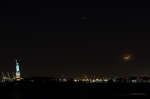
Moonset on January 1 is captured in this sea and night sky snapshot from the port city of New York. Its warm moonlight shining through haze and thin clouds, this New Year's Moon was about 3 days old, in a waxing crescent phase. The visible lunar disk is about 10 percent illuminated.
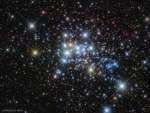 The Massive Stars in Westerlund 1
20.06.2017
Star cluster Westerlund 1 is home to some of the largest and most massive stars known. It is headlined by the star Westerlund 1-26, a red supergiant star so big that if placed in the center of our Solar System, it would extend out past the orbit of Jupiter.
|
January February March April May June July August September |
|||||||||||||||||||||||||||||||||||||||||||||||||