
|
You entered: apod
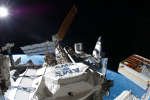 Space Station Detector Finds Unexplained Positron Excess
6.10.2014
Where did all these high energy positrons come from? The Alpha Magnetic Spectrometer (AMS-02) onboard the International Space Station (ISS) has been meticulously recording how often it is struck by both high energy electrons and positrons since 2011.
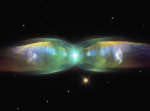 M2 9: Wings of a Butterfly Nebula
13.09.2020
Are stars better appreciated for their art after they die? Actually, stars usually create their most artistic displays as they die. In the case of low-mass stars like our Sun and M2-9 pictured here, the stars transform themselves from normal stars to white dwarfs by casting off their outer gaseous envelopes.
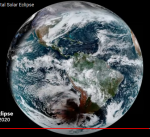 Earth During a Total Solar Eclipse
29.12.2020
What does the Earth look like during a total solar eclipse? It appears dark in the region where people see the eclipse, because that's where the shadow of the Moon falls. The shadow...
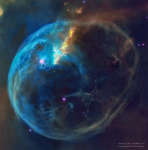 The Bubble Nebula from Hubble
23.03.2022
Massive stars can blow bubbles. The featured image shows perhaps the most famous of all star-bubbles, NGC 7635, also known simply as The Bubble Nebula. Although it looks delicate, the 7-light-year diameter bubble offers evidence of violent processes at work.
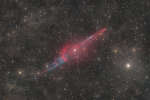 The Bipolar Jets of KX Andromedae
5.12.2025
Blasting outward from variable star KX Andromedae, these stunning bipolar jets are 19 light-years long. Recently discovered, they are revealed in unprecedented detail in this deep telescopic image centered on KX And and composed from over 692 hours of combined image data.
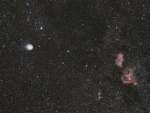 A Year of Spectacular Comets
31.12.2007
Two spectacular comets graced Earth's skies during 2007. Both comets became bright enough to be seen by the unaided eye of the casual sky enthusiast. Early in 2007, Comet McNaught grew brighter than any comet in 40 years, displaying a beautiful dust tail that flowed across the sky.
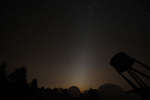 Zodiacal Light Over New Mexico
14.12.2008
An unusual triangle of light is visible this time of year just before dawn. Once considered a false dawn, this triangle of light is actually Zodiacal Light, light reflected from interplanetary dust particles. The triangle is clearly visible in the above image taken from New Mexico, USA, in October.
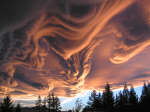 Asperatus Clouds Over New Zealand
27.02.2013
What kind of clouds are these? Although their cause is presently unknown, such unusual atmospheric structures, as menacing as they might seem, do not appear to be harbingers of meteorological doom. Known informally...
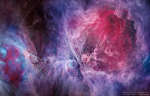 The Orion Nebula in Visible and Infrared
17.05.2016
The Great Nebula in Orion is a colorful place. Visible to the unaided eye, it appears as a small fuzzy patch in the constellation of Orion. Long exposure, multi-wavelength images like this, however, show the Orion Nebula to be a busy neighborhood of young stars, hot gas, and dark dust.
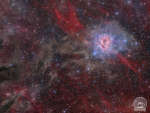 Cocoon Nebula Deep Field
19.09.2018
Inside the Cocoon Nebula is a newly developing cluster of stars. The cosmic Cocoon on the upper right also punctuates a long trail of obscuring interstellar dust clouds to its left. Cataloged...
|
January February March April May June July August September |
|||||||||||||||||||||||||||||||||||||||||||||||||