
|
You entered: Earth
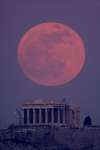 Parthenon Moon
20.03.2011
Did you see the Full Moon last night? Near the horizon, the lunar orb may have seemed to loom large, swollen in appearance by the famous Moon illusion. But the Full Moon really...
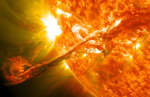 A Solar Filament Erupts
20.07.2014
What's happened to our Sun? Nothing very unusual -- it just threw a filament. Toward the middle of 2012, a long standing solar filament suddenly erupted into space producing an energetic Coronal Mass Ejection (CME).
 Lunations
12.09.2018
Our Moon's appearance changes nightly. As the Moon orbits the Earth, the half illuminated by the Sun first becomes increasingly visible, then decreasingly visible. The featured video animates images taken by NASA's Moon-orbiting Lunar Reconnaissance Orbiter to show all 12 lunations that appear this year, 2018.
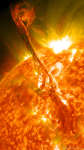 A Solar Filament Erupts
16.09.2018
What's happened to our Sun? Nothing very unusual -- it just threw a filament. Toward the middle of 2012, a long standing solar filament suddenly erupted into space producing an energetic Coronal Mass Ejection (CME).
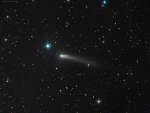 Rosetta's Comet in View
10.09.2021
Faint comet Churyumov-Gerasimenko (67P) sweeps past background stars in the constellation Taurus and even fainter distant galaxies in this telescopic frame from September 7. About 5 years ago, this comet's 4 kilometer spanning...
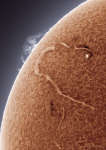 A Long Snaking Filament on the Sun
13.09.2022
Earlier this month, the Sun exhibited one of the longer filaments on record. Visible as the bright curving streak around the image center, the snaking filament's full extent was estimated to be over half of the Sun's radius -- more than 350,000 kilometers long.
 APOD: 2023 June 14 Б The Shark Nebula
14.06.2023
There is no sea on Earth large enough to contain the Shark nebula. This predator apparition poses us no danger as it is composed only of interstellar gas and dust. Dark dust like that featured here is somewhat like cigarette smoke and created in the cool atmospheres of giant stars.
 Rigel and the Witch Head Nebula
31.10.2024
By starlight, this eerie visage shines in the dark with a crooked profile evoking its popular name, the Witch Head Nebula. In fact, this entrancing telescopic portrait gives the impression that a witch has fixed her gaze on Orion's bright supergiant star Rigel.
 APOD: 2025 March 16 Б Venus and the Triply Ultraviolet Sun
16.03.2025
This was a very unusual type of solar eclipse. Typically, it is the Earth's Moon that eclipses the Sun. In 2012, though, the planet Venus took a turn. Like a solar eclipse by the Moon, the phase of Venus became a continually thinner crescent as Venus became increasingly better aligned with the Sun.
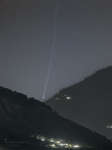 APOD: 2026 April 20 Б Comet R3 PanSTARRS over a Himalayan Valley
20.04.2026
The best way to see comet R3 PanSTARRSБs long tail is with a camera. This week, the recently brightened comet appears in northern skies to the east just before dawn, but is only barely visible to the unaided eye.
|
January February March April May June July August September October |
|||||||||||||||||||||||||||||||||||||||||||||||||