
|
You entered: Earth
 APOD: 2025 July 20 Б Lunar Nearside
20.07.2025
About 1,300 images from the Lunar Reconnaissance Orbiter spacecraft's wide angle camera were used to compose this spectacular view of a familiar face - the lunar nearside. But why is there a lunar nearside? The Moon rotates on its axis and orbits the Earth at the same rate, about once every 28 days.
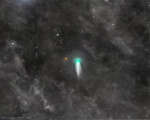 APOD: 2026 August 24 Б Comet 220P in Outburst
24.08.2026
Comet 220P is unexpectedly bright. Normally, periodic Comet 220P/McNaught is so dim that to see it requires a telescope. Two surprising outbursts this year, however, have made it about 20,000 times brighter than usual, so that it is now visible with binoculars and long-duration camera exposures.
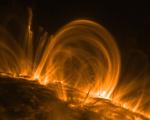 Heating Coronal Loops
28.09.2000
Extending above the photosphere or visible surface of the Sun, the faint, tenuous solar corona can't be easily seen from Earth, but it is measured to be hundreds of times hotter than the photosphere itself. What makes the solar corona so hot?
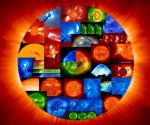 SOHO s Uninterrupted View of the Sun
1.12.2005
Launched ten years ago this week, SOHO (the SOlar and Heliospheric Observatory) still enjoys an uninterrupted view of the Sun. Twelve sungazing instruments on board the spacecraft have explored the Sun's internal structure...
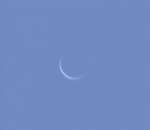 Venus Near Inferior Conjunction
9.04.2009
This remarkable picture of a slender crescent Venus was made during daylight hours on March 26. Venus was then very near inferior conjunction, its closest approach to a point on a line directly between Earth and the Sun.
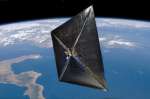 NanoSail D
28.01.2011
Featured in this artist's illustration, NASA's NanoSail-D finally unfurled a very thin, 10 square meter reflective sail on January 20th, becoming the first solar sail spacecraft in low Earth orbit. Often considered...
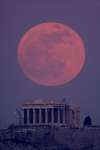 Parthenon Moon
20.03.2011
Did you see the Full Moon last night? Near the horizon, the lunar orb may have seemed to loom large, swollen in appearance by the famous Moon illusion. But the Full Moon really...
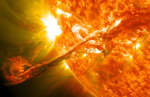 A Solar Filament Erupts
20.07.2014
What's happened to our Sun? Nothing very unusual -- it just threw a filament. Toward the middle of 2012, a long standing solar filament suddenly erupted into space producing an energetic Coronal Mass Ejection (CME).
 Lunations
12.09.2018
Our Moon's appearance changes nightly. As the Moon orbits the Earth, the half illuminated by the Sun first becomes increasingly visible, then decreasingly visible. The featured video animates images taken by NASA's Moon-orbiting Lunar Reconnaissance Orbiter to show all 12 lunations that appear this year, 2018.
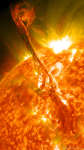 A Solar Filament Erupts
16.09.2018
What's happened to our Sun? Nothing very unusual -- it just threw a filament. Toward the middle of 2012, a long standing solar filament suddenly erupted into space producing an energetic Coronal Mass Ejection (CME).
|
January February March April May June July August September October |
|||||||||||||||||||||||||||||||||||||||||||||||||