
|
You entered: Earth
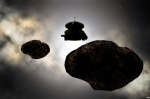 New Horizons at Ultima Thule
29.12.2018
When we celebrate the start of 2019, on January 1 the New Horizons spacecraft will flyby Ultima Thule. A world of the Kuiper belt 6.5 billion kilometers from the Sun, the nickname Ultima Thule (catalog designation 2014 MU69) fittingly means "beyond the known world".
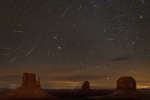 Geminids and the Mittens
25.12.2022
Asteroid 3200 Phaethon's annual gift to planet Earth always arrives in December. Otherwise known as the Geminid meteor shower, the source of the meteroid stream is dust shed along the orbit of the mysterious asteroid.
 APOD: 2025 July 30 Б Coronal Loops on the Sun
30.07.2025
Our Sun frequently erupts in loops. Hot solar plasma jumps off the Sun's surface into prominences, with the most common type of prominence being a simple loop. The loop shape originates from the Sun's magnetic field, which is traced by spiraling electrons and protons.
 Highlights of the Summer Sky
27.06.2018
What can you see in the night sky this summer? The featured graphic gives a few highlights for Earth's northern hemisphere. Viewed as a clock face centered at the bottom, early (northern) summer sky events fan out toward the left, while late summer events are projected toward the right.
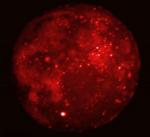 Eclipsed Moon in Infrared
15.09.2001
The total lunar eclipse of September 1996 disappointed many observers in North America who were cursed with cloudy skies. However, the Midcourse Space Experiment (MSX) satellite had a spectacular view from Earth orbit and SPIRIT III, an onboard infrared telescope, was used to repeatedly image the moon during the eclipse.
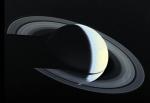 Saturn At Night
4.03.2000
From a spectacular vantage point over 1.4 billion kilometers from the sun, the Voyager 1 spacecraft looked back toward the inner solar system to record this startling view of Saturn's nightside. The picture was taken on November 16, 1980, some four days after the robot spacecraft's closest approach to the gorgeous gas giant.
 Distorted Green Flash Sunset over Italy
8.09.2015
This was one strange sunset. For one thing, the typically round Sun appeared distorted, geometrically, and multiply layered. For another, some of these layers appeared unusually green. The Sun, of course, was just fine -- its odd appearance was caused entirely by its light refracting in the Earth's atmosphere.
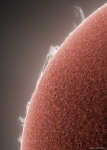 Active Prominences on a Quiet Sun
20.08.2018
Why is the Sun so quiet? As the Sun enters into a period of time known as a Solar Minimum, it is, as expected, showing fewer sunspots and active regions than usual. The quietness is somewhat unsettling, though, as so far this year, most days show no sunspots at all.
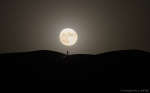 Full Moonlight
18.11.2021
A photographer in silhouette stands in bright moonlight as the Full Moon rises in this well-planned telephoto image. Of course, the Full Moon is normally the brightest lunar phase. But on November 18/19, the Full Moon's light will be dimmed during a deep partial lunar eclipse seen across much of planet Earth.
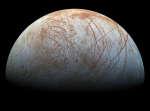 Galileo's Europa
15.01.2022
Looping through the Jovian system in the late 1990s, the Galileo spacecraft recorded stunning views of Europa and uncovered evidence that the moon's icy surface likely hides a deep, global ocean. Galileo...
|
January February March April May June July August September October |
|||||||||||||||||||||||||||||||||||||||||||||||||