
|
You entered: Earth
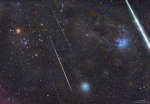 Stars, Meteors, and a Comet in Taurus
7.01.2019
This was an unusual night to look in the direction of the Bull. The constellation Taurus is always well known for hosting two bright star clusters -- the Pleaides, visible on the right, and the comparatively diffuse Hyades, visible on the left.
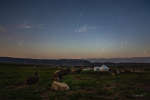 The Perseids and the Plough
15.08.2019
Despite interfering moonlight, many denizens of planet Earth were able to watch this year's Perseid meteor shower. This pastoral scene includes local skygazers admiring the shower's brief, heavenly flashes in predawn hours near peak activity on August 13 from Nalati Grassland in Xinjiang, China.
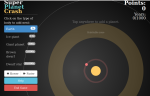 Game: Super Planet Crash
19.06.2022
Can you create a planetary system that lasts for 1000 years? Super Planet Crash, the featured game, allows you to try. To create up to ten planets, just click anywhere near the central star.
 APOD: 2024 February 26 Б Martian Moon Eclipses Martian Moon
26.02.2024
What if there were two moons in the sky -- and they eclipsed each other? This happens on Mars. The featured video shows a version of this unusual eclipse from space. Pictured are the two moons of Mars: the larger Phobos, which orbits closer to the red planet, and the smaller Deimos, which orbits further out.
 APOD: 2025 April 23 Б An Almost Everything Sky
23.04.2025
This surprising sky has almost everything. First, slanting down from the upper left and far in the distance is the central band of our Milky Way Galaxy. More modestly, slanting down from the upper right and high in Earth's atmosphere is a bright meteor.
 APOD: 2025 July 24 Б Titan Shadow Transit
24.07.2025
Every 15 years or so, Saturn's rings are tilted edge-on to our line of sight. As the bright, beautiful ring system grows narrower and fainter it becomes increasingly difficult to see for denizens of planet Earth.
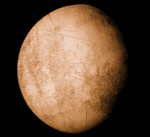 Europa: Oceans of Life?
6.08.1996
Is there life beneath Europa's frozen surface? Some believe the oceans found there of carbon-enriched water are the best chance for life, outside the Earth, in our Solar System. Europa, the fourth largest moon of Jupiter, was recently discovered to have a thin oxygen atmosphere by scientists using the Hubble Space Telescope.
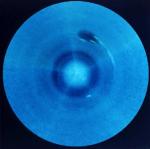 Southern Neptune
29.05.1997
Neptune, the Solar System's outermost gas giant planet, is 30 times farther from the Sun than Earth. Twelve years after a 1977 launch, Voyager 2 flew by Neptune and found surprising activity on a planet that receives only 3 percent as much sunlight as Jupiter.
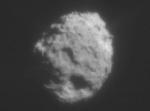 Comet Wild 2s Nucleus from Stardust
3.01.2004
What does a comet nucleus look like? Yesterday the robot spacecraft Stardust answered this question by returning the most detailed images yet of the center of a comet. The icy centers of comets are usually hidden from Earth-bound telescopes by opaque dust and gas that boils off during approach to the Sun.
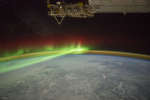 Aurora and Manicouagan Crater from the Space Station
29.05.2018
How many of these can you find in today's featured photograph: an aurora, airglow, one of the oldest impact craters on the Earth, snow and ice, stars, city lights, and part of the International Space Station? Most of these can be identified by their distinctive colors.
|
January February March April May June July August September October |
|||||||||||||||||||||||||||||||||||||||||||||||||