
|
You entered: Sun
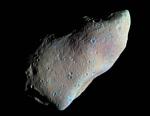 Asteroid Gaspra s Best Face
27.10.2002
Asteroid 951 Gaspra is a huge rock tumbling in space. Gaspra became one of the best-studied spacecraft Galileo flew by. In the above photograph, subtle color variations have been exaggerated to highlight changes in reflectivity, surface structure and composition.
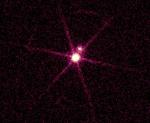 X-Rays From Sirius B
6.10.2000
In visible light Sirius A (Alpha Canis Majoris) is the brightest star in the night sky, a closely watched celestial beacon throughout recorded history. Part of a binary star system only 8 light-years away, it was known in modern times to have a small companion star, Sirius B.
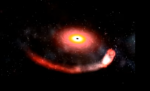 Unusual Signal Suggests Neutron Star Destroyed by Black Hole
3.09.2019
What created this unusual explosion? Three weeks ago, gravitational wave detectors in the USA and Europe -- the LIGO and Virgo detectors -- detected a burst of gravitational radiation that had the oscillating pattern expected when a black hole destroys a neutron star.
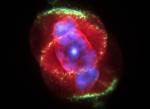 X-rays From The Cat's Eye
11.01.2001
Haunting patterns within planetary nebula NGC 6543 readily suggest its popular moniker -- the Cat's Eye nebula. In 1995, a stunning false-color optical image from the Hubble Space Telescope detailed the swirls of this glowing nebula, known to be the gaseous shroud expelled from a dying sun-like star about 3,000 light-years from Earth.
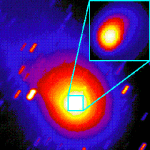 Periodic Comet Swift-Tuttle
19.02.1996
Comet Swift-Tuttle, shown above in false color, is the largest object known to make repeated passes near the Earth. It is also one of the oldest known periodic comets with sightings spanning two millennia.
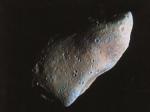 Asteroid Gaspra's Best Face
12.07.1998
Asteroid 951 Gaspra is a huge rock tumbling in space. Gaspra became one of the best-studied asteroids in 1991 when the spacecraft Galileo flew by. In the above photograph, subtle color variations have been exaggerated to highlight changes in reflectivity, surface structure and composition.
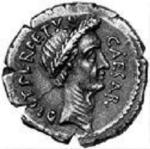 Julius Caesar and Leap Days
29.02.2000
Even as leap days go, today is a remarkable one. In 46 BC, Julius Caesar, pictured above in a self-decreed minted coin, created a calendar system that added one leap day every four years.
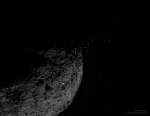 Gravel Ejected from Asteroid Bennu
16.09.2020
Why does asteroid Bennu eject gravel into space? No one is sure. The discovery, occurring during several episodes by NASA's visiting ORISIS-REx spacecraft, was unexpected. Leading ejection hypotheses include impacts by Sun-orbiting meteoroids, sudden thermal fractures of internal structures, and the sudden release of a water vapor jet.
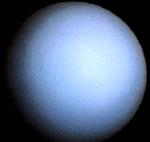 Uranus: The Tilted Planet
15.11.1997
Uranus is the third largest planet after Jupiter and Saturn. This picture was snapped by the Voyager 2 spacecraft in 1986 - the only spacecraft ever to visit Uranus. Uranus has many moons and a ring system. Uranus is composed mostly of rock and ices, but with a thick hydrogen and helium atmosphere.
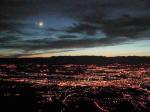 The Moon and Venus Over Geneva
19.06.2002
The Moon, fresh from a biting encounter with the Sun last week, appeared next to threaten Venus. The waxing Moon appeared to glide right past, however, just a few degrees away. Venus, of course, is much further away from the Earth than the Moon, so the passing was really just an angular illusion.
|
January February March April May |
|||||||||||||||||||||||||||||||||||||||||||||||||