
|
You entered: Sun
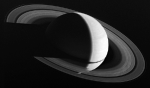 Looking Down on Saturn
17.07.1996
This picture of Saturn could not have been taken from Earth. No Earth based picture could possibly view the night side of Saturn and the corresponding shadow cast across Saturn's rings. Since Earth is much closer to the Sun than Saturn, only the day side of the planet is visible from the Earth.
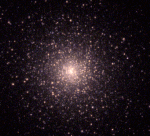 M15: A Great Globular Cluster
26.07.1995
A globular cluster is a system of about one million stars that together orbit a galaxy. One of the brightest globular clusters in our Milky Way galaxy is the pictured M15, the fifteenth object on Messier's list of diffuse objects on our sky.
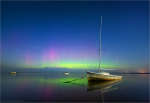 Calm Waters and Geomagnetic Storm
9.09.2017
Very recognizable stars of the northern sky are a backdrop for calm waters in this moonlit sea and skyscape off Cape Cod, Massachusetts. Taken on September 7, the photo also records a colorful display of northern lights or aurora borealis triggered by a severe geomagnetic storm.
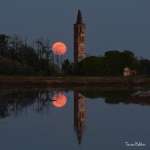 Full Flower Moonrise
9.05.2020
Rising as the Sun set, the Moon was bright and full in planet Earth skies on May 7 and known to some as a Flower Moon. Near the horizon it does seem to take on rose pink hues of reddened sunlight in this reflective twilight scene.
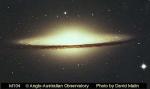 M104: The Sombrero Galaxy
15.08.1999
What's going on in the center of this spiral galaxy? Named the Sombrero Galaxy for its hat-like resemblance, M104 features a prominent dust lane and a bright halo of stars and globular clusters.
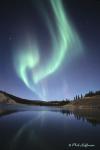 Dueling Auroras
3.12.2001
Will it be curtains for one of these auroras? A quick inspection indicates that it is curtains for both, as the designation "curtains" well categorizes the type of aurora pattern pictured. Another (informal) type is the corona. The above auroras resulted from outbursts of ionic particles from the Sun during the last week of September.
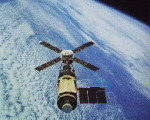 Skylab Over Earth
30.08.1995
Skylab was an orbiting laboratory launched by a Saturn V rocket in May 1973. Skylab was visited three times by NASA astronauts who sometimes stayed as long as two and a half months. Many scientific tests were preformed on Skylab, including astronomical observations in ultraviolet and X-ray light.
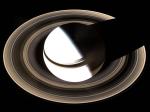 Saturn from Above
6.03.2007
This image of Saturn could not have been taken from Earth. No Earth based picture could possibly view the night side of Saturn and the corresponding shadow cast across Saturn's rings. Since Earth is much closer to the Sun than Saturn, only the day side of the planet is visible from the Earth.
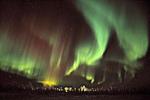 Aurora Over Circle, Alaska
1.01.1997
Aurora can make spectacular sights. This particular aurora was photographed hovering over the town of Circle, Alaska. Although Aurora might first appear to be moonlit clouds, they only add light to the sky, and hence can not block background stars from view.
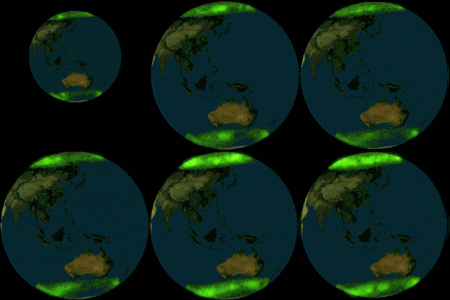 Auroras Over Both Earth Poles
14.11.2001
Auroras in the north and south can be nearly mirror images of each other. Such mirroring had been suspected for centuries but dramatically confirmed only last month by detailed images from NASA's orbiting Polar spacecraft.
|
January February March April May |
|||||||||||||||||||||||||||||||||||||||||||||||||