
|
You entered: Sun
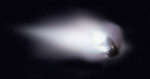 Comet Halleys Nucleus: An Orbiting Iceberg
4.01.2010
What does a comet nucleus look like? Formed from the primordial stuff of the Solar System, comet nuclei were thought to resemble very dirty icebergs. But ground-based telescopes revealed only the surrounding cloud of gas and dust of active comets nearing the Sun, clearly resolving only the comet's coma, and the characteristic cometary tails.
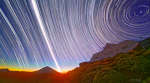 APOD: 2026 March 20 Б Spring Equinox at Teide Observatory
20.03.2026
The defining astronomical moment of the equinox today is at 14:46 UTC (March 20). That's when the Sun crosses the celestial equator moving north in its yearly journey through planet Earth's sky, marking the beginning of spring for our fair planet in the northern hemisphere and fall in the southern hemisphere.
 Mira Over Germany
21.02.2007
What's that new star in the sky? The star might appear new, but it's actually just the variable star Mira near its brightest. Rolling your cursor over the above vertically compressed image...
 Zeta Oph: Runaway Star
29.12.2012
Like a ship plowing through cosmic seas, runaway star Zeta Ophiuchi produces the arcing interstellar bow wave or bow shock seen in this stunning infrared portrait. In the false-color view, bluish Zeta...
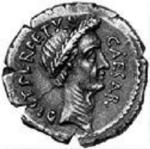 Julius Caesar and Leap Days
29.02.2004
Today, February 29th, is a leap day - a relatively rare occurrence. In 46 BC, Julius Caesar, pictured above in a self-decreed minted coin, created a calendar system that added one leap day every four years.
 The Kepler 90 Planetary System
28.04.2020
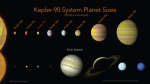
Do other stars have planetary systems like our own? Yes -- one such system is Kepler-90. Cataloged by the Kepler satellite that operated from Earth orbit between 2009 and 2018, eight planets were discovered, giving Kepler-90 the same number of known planets as our Solar System.
 Two Custers and a Comet
30.01.2020
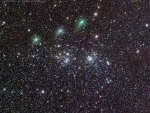
This lovely starfield spans some four full moons (about 2 degrees) across the heroic northern constellation of Perseus. In telescopic exposures made during the nights of January 24, 26, and 28 it holds...
 Zeta Oph: Runaway Star
4.01.2024
Like a ship plowing through cosmic seas, runaway star Zeta Ophiuchi produces the arcing interstellar bow wave or bow shock seen in this stunning infrared portrait. In the false-color view, bluish Zeta...
 The Cats Eye Nebula in Optical and X-ray
7.11.2021
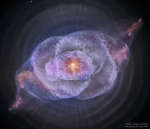
To some it looks like a cat's eye. To others, perhaps like a giant cosmic conch shell. It is actually one of brightest and most highly detailed planetary nebula known, composed of gas expelled in the brief yet glorious phase near the end of life of a Sun-like star.
 Black Hole Candidate Cygnus X 1
11.08.2008
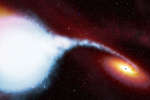
Is that a black hole? Quite possibly. The Cygnus X-1 binary star system contains one of the best candidates for a black hole. The system was discovered because it is one of the brightest...
|
January February March April May |
|||||||||||||||||||||||||||||||||||||||||||||||||