
|
You entered: gas
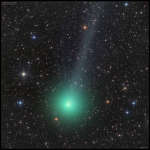 This Comet Lovejoy
24.12.2014
Comet Lovejoy, C/2014 Q2, is framed like a cosmic Christmas tree with starry decorations in this colorful telescopic portrait, snapped on December 16th. Its lovely coma is tinted green by diatomic C2 gas fluorescing in sunlight.
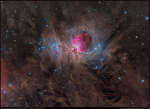 The Great Orion Nebula M42
4.11.2015
The Great Nebula in Orion, also known as M42, is one of the most famous nebulas in the sky. The star forming region's glowing gas clouds and hot young stars are on the right in this sharp and colorful image that includes the bluish reflection nebulae NGC 1977 and friends on the left.
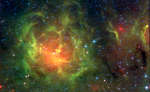 Infrared Trifid
25.07.2015
The Trifid Nebula, also known as Messier 20, is easy to find with a small telescope, a well known stop in the nebula rich constellation Sagittarius. But where visible light pictures show the nebula...
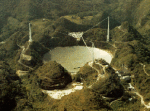 Arecibo: The Largest Telescope
9.03.1996
The Arecibo radio telescope is currently the largest single-dish telescope in the world. First opening in 1963, this 305 meter (1000 foot) radio telescope resides in a natural valley of Puerto Rico. The Arecibo...
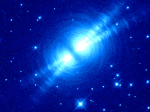 Searchlight Beams from the Egg Nebula
29.01.1996
The dramatic and mysterious looking object revealed in this Hubble Space Telescope image is known as the Egg Nebula. It is an aging star about 3,000 lightyears distant, entering its Planetary Nebula phase of evolution.
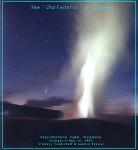 Old Faithful Meets Hale-Bopp
26.05.1997
As Comet Hale-Bopp leaves our Northern Skies, it provides us with yet another burst of joy. On May 11th the fading comet was photographed behind the famous "Old Faithful" water geyser of Yellowstone National Park, Wyoming, USA, Planet Earth.
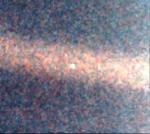 The Largest Rock Known
1.01.1998
There, that faint dot in the center - that's the largest rock known. It is larger than every known asteroid, moon, and comet nucleus. It is larger than any other rocky planet. (Nobody knows...
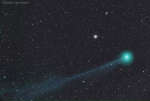 Comet Lovejoy before a Globular Star Cluster
30.12.2014
Comet Lovejoy has become visible to the unaided eye. To see the comet, just go outside an hour or so after sunset and look for a fuzzy patch to the right of Orion's belt. Binoculars and a star chart may help.
 East of the Lagoon Nebula
20.05.2002
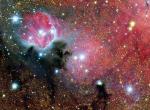
To the east of the Lagoon Nebula is a star field rich in diversity. On the lower left are clouds rich in dark dust that hide background stars and young star systems still forming. Dark clouds include LDN 227 on the left and IC 1275 on the right, with a bright star near its tip.
 M101: An Ultraviolet View
8.06.1997
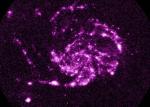
This giant spiral galaxy, Messier 101 (M101), was photographed by the Ultraviolet Imaging Telescope (UIT). UIT flew into orbit as part of the Astro 2 mission on-board the Space Shuttle Endeavour in March 1995. The image has been processed so that the colors (purple to white) represent an increasing intensity of ultraviolet light.
|
January February |
|||||||||||||||||||||||||||||||||||||||||||||||||