
|
You entered: gas
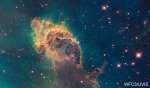 Carina Nebula Dust Pillar
7.02.2015
This cosmic pillar of gas and dust is nearly two light-years wide. The structure lies within one of our galaxy's largest star forming regions, the Carina Nebula, shining in southern skies at a distance of about 7,500 light-years.
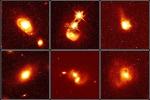 A Quasar Portrait Gallery
6.12.1997
QUASARs (QUASi-stellAR objects) lie near the edge of the observable Universe. Discovered in 1963, astronomers were astounded that such objects could be visible across billions of light-years, as this implies they must emit prodigious amounts of energy. Where does the energy come from?
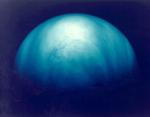 Venus: Just Passing By
25.06.2005
Venus, the second closest planet to the Sun, is by far the brightest of the three planets gathered in this weekend's western sky at sunset. It has also proven to be a popular way-point for spacecraft headed for the gas giant planets in the outer reaches of the solar system. Why visit Venus first?
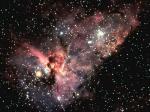 The Keyhole Nebula
23.05.1999
The dark dusty Keyhole Nebula gets its name from its unusual shape. Officially designated NGC 3324, the Keyhole Nebula is a smaller region superposed on the larger Eta Carina Nebula. These nebulae were created by the dying star Eta Carina, which is prone to violent outbursts during its final centuries.
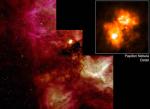 N159 and the Papillon Nebula
14.06.1999
In a search for massive stars, the Hubble Space Telescope has peered into yet another spectacular region of star formation. This nebula, known as N159, spans over 150 light-years and is located in the neighboring Large Magellanic Cloud galaxy, about 170,000 light years distant.
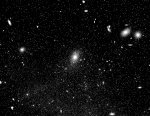 The Virgo Cluster of Galaxies
20.02.2000
Pictured are several galaxies of the Virgo Cluster, the closest cluster of galaxies to our Milky Way Galaxy. The Virgo Cluster spans more than 5 degrees on the sky - about 10 times the angle made by a full Moon. It contains over 100 galaxies of many types - including spirals, ellipticals, and irregular galaxies.
 Panorama of the Whale Galaxy
17.05.2010
The see the full length of this blue whale, scroll right. NGC 4631 is a big beautiful spiral galaxy seen edge-on at only about 30 million light-years away. This galaxy's slightly distorted wedge shape led to its popular moniker of the Whale galaxy.
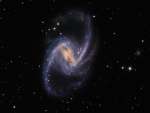 NGC 1365: Majestic Island Universe
20.08.2010
Barred spiral galaxy NGC 1365 is truly a majestic island universe some 200,000 light-years across. Located a mere 60 million light-years away toward the chemical constellation Fornax, NGC 1365 is a dominant member of the well-studied Fornax galaxy cluster.
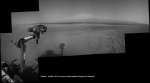 Curiosity on Mars: Mt Sharp in View
27.08.2012
What's that on the horizon? The light peak is Mt. Sharp -- an eventual destination of the Curiosity rover. The above image mosaic was taken from Bradbury Landing, the landing spot of Curiosity, and shows in the foreground the rover's extended robotic arm.
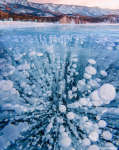 Methane Bubbles Frozen in Lake Baikal
18.12.2018
What are these bubbles frozen into Lake Baikal? Methane. Lake Baikal, a UNESCO World Heritage Site in Russia, is the world's largest (by volume), oldest, and deepest lake, containing over 20% of the world's fresh water.
|
January February |
|||||||||||||||||||||||||||||||||||||||||||||||||