
|
You entered: gas
 The Snake Nebula from CFHT
9.04.2002
What slithers overhead? The dark winding lanes visible in part of the constellation of Ophiuchus belong to the Snake Nebula. Also known as Barnard 72, the Snake Nebula is a series of dark absorption clouds made up of molecular gas and interstellar dust.
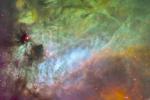 Elements of the Swan Nebula
11.08.2003
In the depths of the dark clouds of dust and molecular gas known as M17, stars continue to form. Also known as the Omega Nebula and Horseshoe Nebula, the darkness of M17's molecular clouds results from background starlight being absorbed by thick filaments of carbon-based smoke-sized dust.
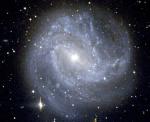 M83: A Barred Spiral Galaxy
25.05.1998
M83 is a bright spiral galaxy that can be found with a small telescope in the constellation of Hydra. M83 is a member of the Centaurus group of galaxies, a nearby group dominated by the massive galaxy Centaurus A. It takes light about 15 million years to reach us from M83.
 Arecibo: The Largest Telescope
12.04.1997
The Arecibo radio telescope is currently the largest single-dish telescope in the world. First opening in 1963, this 305 meter (1000 foot) radio telescope resides in a natural valley of Puerto Rico. The Arecibo telescope has been used for many astronomical research projects, including
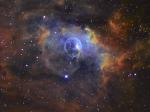 NGC 7635: The Bubble Nebula
6.11.2005
It's the bubble versus the cloud. NGC 7635, the Bubble Nebula, is being pushed out by the stellar wind of massive central star BD+602522. Next door, though, lives a giant molecular cloud, visible above to the lower right.
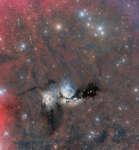 M78 Wide Field
20.01.2021
Interstellar dust clouds and glowing nebulae abound in the fertile constellation of Orion. One of the brightest, M78, is centered in this colorful, wide field view, covering an area north of Orion's belt. At a distance of about 1,500 light-years, the bluish reflection nebula is around 5 light-years across.
 APOD: 2024 December 18 Б NGC 660: Polar Ring Galaxy
17.12.2024
What kind of strange galaxy is this? This rare structure is known as a polar ring galaxy, and it seems to have two different rings of stars. In this galaxy, NGC 660, one ring...
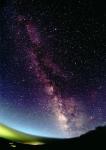 Heaven on Earth
5.11.2000
If sometimes it appears that the entire Milky Way Galaxy is raining down on your head, do not despair. It happens twice a day. As the Sun rises in the East, wonders of the night sky become less bright than the sunlight scattered by our own Earth's atmosphere, and so fade from view.
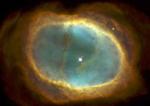 NGC 3132: The Eight Burst Nebula
9.11.1998
It's the dim star, not the bright one, near the center of NGC 3132 that created this odd but beautiful planetary nebula. Nicknamed the Eight-Burst Nebula and the Southern Ring Nebula, the glowing gas originated in the outer layers of a star like our Sun.
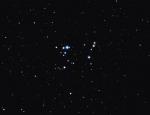 The 37 Cluster
17.11.2005
For the mostly harmless denizens of planet Earth, the brighter stars of open cluster NGC 2169 seem to form a cosmic 37. (Did you expect 42?.) Of course, the improbable numerical asterism appears solely by chance and lies at an estimated distance of 3,600 light-years toward the constellation Orion.
|
January February |
|||||||||||||||||||||||||||||||||||||||||||||||||