
|
You entered: gas
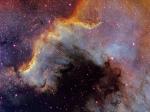 The Cygnus Wall of Star Formation
21.06.2005
The North America Nebula in the sky can do what North Americans on Earth cannot -- form stars. Specifically, in analogy to the Earth-confined continent, the bright part that appears as Central America and Mexico is actually a hot bed of gas, dust, and newly formed stars known as the Cygnus Wall.
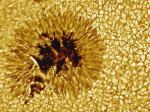 A Sunspot Up Close
5.11.2005
Why would a small part of the Sun appear slightly dark? Visible above is a close-up picture of a sunspot, a depression on the Sun's face that is slightly cooler and less luminous than the rest of the Sun.
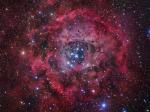 The Rosette Nebula
13.02.2007
Would the Rosette Nebula by any other name look as sweet? The bland New General Catalog designation of NGC 2237 doesn't appear to diminish the appearance of the this flowery emission nebula. Inside the nebula lies an open cluster of bright young stars designated NGC 2244.
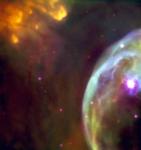 Close Up of the Bubble Nebula
17.11.1998
It's the bubble versus the cloud. NGC 7635, the Bubble Nebula, is being pushed out by the stellar wind of massive central star BD+602522. Next door, though, lives a giant molecular cloud, visible above to the upper left.
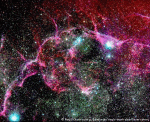 Vela Supernova Remnant in Optical
13.06.1996
About 11,000 years ago a star in the constellation of Vela exploded. This bright supernova may have been visible to the first human farmers. Today the Vela supernova remnant marks the position of a relatively close and recent explosion in our Galaxy. A roughly spherical, expanding shock wave is visible in X-rays.
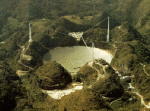 Arecibo: The Largest Telescope
28.11.1998
The Arecibo radio telescope is currently the largest single-dish telescope in the world. First opening in 1963, this 305 meter (1000 foot) radio telescope resides in a natural valley of Puerto Rico. The Arecibo telescope has been used for many astronomical research projects, including
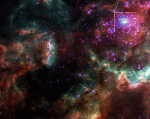 In the Center of 30 Doradus
4.10.1997
In the center of 30 Doradus lies a huge cluster of the largest, hottest, most massive stars known. The center of this cluster, known as R136, is boxed in the upper right portion of the above picture.
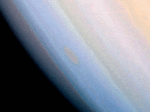 Saturn's Cloud Tops
16.03.1996
This close-up of the tops of Saturn's clouds was taken by the Voyager 1 robot spacecraft as it passed the giant planet in November 1980. Saturn's clouds are mostly composed of hydrogen and helium gas, but the small addition of other elements gives the clouds their colors.
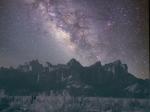 Heaven on Earth
22.02.2004
If sometimes it appears that the entire Milky Way Galaxy is raining down on your head, do not despair. It happens twice a day. As the Sun rises in the East, wonders of the night sky become less bright than the sunlight scattered by our own Earth's atmosphere, and so fade from view.
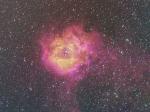 The Rosette Nebula
13.02.2005
Would the Rosette Nebula by any other name look as sweet? The bland New General Catalog designation of NGC 2237 doesn't appear to diminish the appearance of the this flowery emission nebula. Inside the nebula lies an open cluster of bright young stars designated NGC 2244.
|
January February |
|||||||||||||||||||||||||||||||||||||||||||||||||