
|
You entered: gas
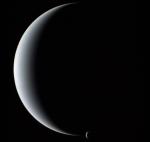 Crescent Neptune and Triton
19.06.2001
Gliding silently through the outer Solar System, the Voyager 2 spacecraft camera captured Neptune and Triton together in crescent phase in 1989. The above picture of the gas giant planet and its cloudy moon was taken from behind just after closest approach.
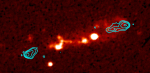 An Energetic Radio Galaxy
30.09.1995
The radio and optical emission seen in the above superposed images of the radio galaxy 3C368 indicate that energetic processes are at work. A radio galaxy is a galaxy that is visible to radio telescopes. A large radio signal usually indicates very powerful phenomena.
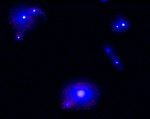 Two Billion Years After the Big Bang
7.09.1996
What did the universe look like two billion years after the Big Bang? According to this computer model, the universe was filled with irregular looking objects like the ones shown above. The simulation then predicts that these blobs of stars and gas collide to form galaxies more similar to the ones we see today.
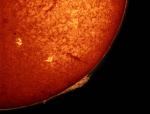 Orange Sun Simmering
29.07.2003
Even a quiet Sun is a busy place. The above image, taken in a single color of light called Hydrogen Alpha, records a great amount of detail of the simmering surface of our parent star.
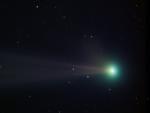 Colors of Comet Pojmanski
11.03.2006
Comet Pojmanski flew by planet Earth last weekend on a surprise trip through the inner solar system. Then an easy binocular target for morning skygazers, Pojmanski ultimately showed off a long tail, but it also presented some lovely green-blue hues as gas molecules in its tenuous coma and tail fluoresced in the sunlight.
 Europa: Discover Life Under the Ice
1.04.2016
Looking for an interplanetary vacation destination? Consider a visit to Europa, one of the Solar System's most tantalizing moons. Ice-covered Europa follows an elliptical path in its 85 hour orbit around our ruling gas giant Jupiter.
 APOD: 2025 January 22 Б The North America Nebula
22.01.2025
The North America nebula on the sky can do what the North America continent on Earth cannot -- form stars. Specifically, in analogy to the Earth-confined continent, the bright part that appears as the east coast is actually a hot bed of gas, dust, and newly formed stars known as the Cygnus Wall.
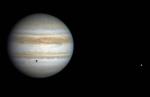 Cassini Spacecraft Approaches Jupiter
11.10.2000
A new spacecraft has entered the outer Solar System: Cassini. Launched in 1997 and bound for Saturn in 2004, Cassini sent back the above image last week while approaching the giant planet Jupiter. Cassini joins the Galileo spacecraft currently in orbit around Jupiter in studying the gas giant and its moons.
 The Long Jet of Pictor A
19.06.2000
A jet stretching nearly a million light years has been imaged emanating from galaxy Pictor A. The thin jet of electrons and protons shoots out at nearly light-speed likely from the vicinity of a large black hole at the galaxy center.
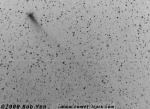 Comet LINEAR Extends
10.07.2000
Comet LINEAR's tail appears to be extending. Many sky watchers are closely following Comet C/1999 S4 LINEAR and wondering if it will develop an impressive tail or become visible to the naked eye later this month.
|
January February March April May |
|||||||||||||||||||||||||||||||||||||||||||||||||