
|
You entered: gas
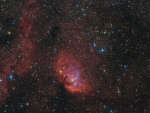 The Tulip in the Swan
21.09.2019
Framing a bright emission region, this telescopic view looks out across a pretty field of stars along the plane of our Milky Way Galaxy, toward the nebula rich constellation Cygnus the Swan. Popularly called...
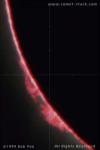 At The Suns Edge
20.08.1999
This dramatic set of prominences looms beyond the edge of the sun. The image was captured by astrophotographer Bob Yen as he stood in the moon's shadow near Bagdere, Turkey on August 11 for the millennium's last total solar eclipse.
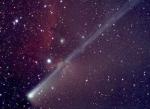 Comet SOHO and Nebulae in Orion
4.06.1998
Astrophotographer Michael Horn captured this gorgeous view of comet SOHO in the dark night sky above Wandibindle, Queensland, Australia on May 23rd. On this date, comet SOHO was moving against the background of the nebula-rich constellation of Orion.
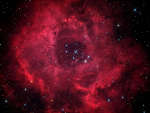 The Rosette Nebula
14.02.2012
The Rosette Nebula is not the only cosmic cloud of gas and dust to evoke the imagery of flowers -- but it is the most famous. At the edge of a large molecular cloud...
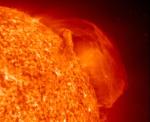 Erupting Sun
18.09.1997
On August 27th twisting magnetic fields propelled this huge eruptive prominence a hundred thousand miles above the Sun's surface. The seething plasma of ionized gases is at a temperature of about 150,000 degrees Farenheit and spans over 200,000 miles (about 27 Earths).
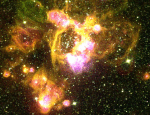 Superbubbles in the LMC
3.07.1996
Why is there a hole in the center of this nebula? A leading explanation is that it is caused by the stellar winds from the stars that live there. Stars - including the Sun - expel electrons, protons, and other charged ions in a steady stream - the stellar wind.
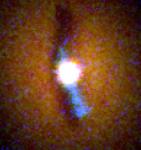 The Center of NGC 6251 is Glowing
12.09.1997
Something is lighting up the center of galaxy NGC 6251. Leading speculation holds that it is a large black hole not shrouded by gas and dust typically found near the center of a galaxy.
 NGC 2440: Cocoon of a New White Dwarf
11.01.2004
Like a butterfly, a white dwarf star begins its life by casting off a cocoon that enclosed its former self. In this analogy, however, the Sun would be a caterpillar and the ejected shell of gas would become the prettiest of all!
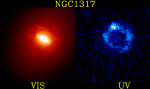 Starburst Ring in Galaxy NGC 1317
11.12.1996
Where do stars form? A typical place is an area of dense nebular gas common to arms in spiral galaxies. Sometimes, however, a burst of star formation can occur with unusual geometry. Nearby galaxy NGC 1317 shows such an unusual ring of star formation surrounding its barred nucleus.
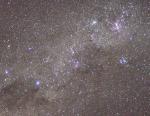 The Southern Sky from the International Space Station
7.05.2003
Look up from Earth's South Pole, and this stellar starscape is what you might see. Alternatively, this patch of sky is also visible from many southern locations as well as the orbiting International Space Station, where the above image was recently recorded.
|
January February March April May |
|||||||||||||||||||||||||||||||||||||||||||||||||