
|
You entered: gas
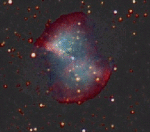 M27: The Dumbbell Nebula
29.07.1995
The Dumbbell Nebula is a beautiful red and blue planetary nebula in the constellation of Vulpecula. It is the 27th object on Charles Messier's list of diffuse sky objects, and so is referred to as M27. Its high surface brightness makes it a good target for small telescopes.
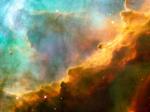 M17: A Hubble Close Up
25.04.2003
Sculpted by stellar winds and radiation, these fantastic, undulating shapes lie within the stellar nursery known as M17, the Omega Nebula, some 5,500 light-years away in the nebula-rich constellation Sagittarius. The lumpy features...
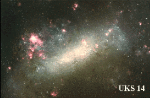 The Large Cloud Of Magellan (LMC)
23.01.1998
Ferdinand Magellan and his crew had plenty of time to study the southern sky during their famous voyage around the world. As a result, two fuzzy cloud-like objects, not visible to northern hemisphere dwellers, are now known as the Clouds of Magellan.
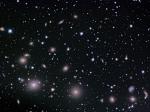 The Perseus Cluster of Galaxies
25.10.2004
Here is one of the largest objects that anyone will ever see on the sky. Each of the fuzzy blobs in the above picture is a galaxy, together making up the Perseus Cluster, one of the closest clusters of galaxies.
 A Solar System Portrait
5.05.1999
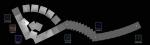
As the Voyager 1 spacecraft headed out of our Solar System, it looked back and took a parting family portrait of the Sun and planets. From beyond Pluto, our Solar System looks like a bright star surrounded by faint dots. In the above picture, the Sun is so bright it is blocked out for contrast.
 Spiral Galaxy NGC 2841
28.03.2008
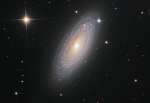
Some 50 million light-years distant, spiral galaxy NGC 2841 can be found in the northern constellation of Ursa Major. This sharp view of the gorgeous island universe shows off a striking yellow nucleus and galactic disk with tightly wound spiral arms.
 Vela Supernova Remnant
31.12.2014
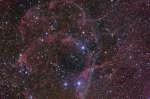
The plane of our Milky Way Galaxy runs through this complex and beautiful skyscape. At the northwestern edge of the constellation Vela (the Sails) the telescopic frame is over 10 degrees wide, centered on the brightest glowing filaments of the Vela Supernova Remnant, an expanding debris cloud from the death explosion of a massive star.
 Star Cluster R136 Bursts Out
23.01.2016
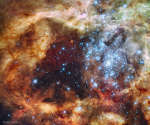
In the center of star-forming region 30 Doradus lies a huge cluster containing some of the largest, hottest, and most massive stars known. These stars, known collectively as star cluster R136, were captured in the featured image in visible light by the Wide Field Camera 3 in 2009 peering through the Hubble Space Telescope.
 APOD: 2024 June 10 Б Sh2 132: The Lion Nebula
9.06.2024
Is the Lion Nebula the real ruler of the constellation Cepheus? This powerful feline appearing nebula is powered by two massive stars, each with a mass over 20 times greater than our Sun. Formed...
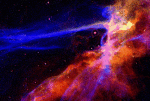 Rampaging Fronts of the Veil Nebula
6.03.1996
A supernova explosion of a high-mass star results in fast moving blast waves. At the front of the waves shown above, ionized gas in the Veil Supernova Remnant rushes out from the explosion, sweeps up material, and breaks up many atoms into constituent ions and electrons.
|
January February March April May |
|||||||||||||||||||||||||||||||||||||||||||||||||